
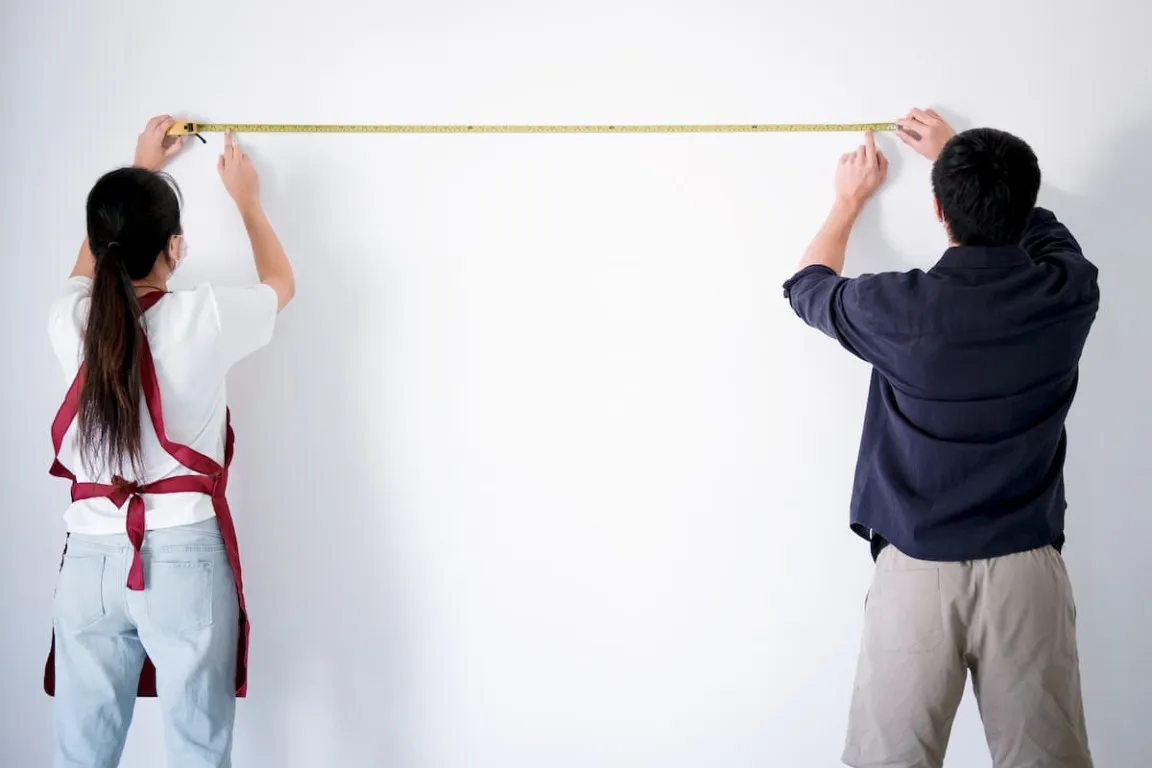
You can achieve an aesthetically pleasing look for your house by focusing on wall renovation and decoration. The renovation process can also be an opportunity to address wall issues and damage, such as cracks or efflorescence.
Before repainting, hanging wallpaper, or installing tile during a wall renovation, calculate the wall’s surface area first. That way, you can accurately estimate the material you need without running short.
Accurately estimating material needs not only saves money but also ensures the quality of the final renovation. This is because materials like paint, wallpaper, and tile should ideally be purchased all at once. Buying materials in stages risks different colors or patterns because production batches can vary.
Therefore, accurately calculating the wall area at the outset helps ensure the renovation delivers the best possible results and stays neat, cost-effective, and efficient, without wasting time making multiple trips to buy additional materials.
To better understand how to calculate wall area, see the full discussion below.
How to Effectively Calculate Wall Area
Generally speaking, calculating wall area is quite simple. Depending on the wall's shape, you can calculate its area using the formula for a flat surface. For example, if a wall is square, calculate its area using the formula: side × side.
Next, to calculate the total wall surface area of the room, simply add up the areas of each wall. Also take into account the presence of doors, windows, and vents.
Example
You want to calculate the wall surface area of a room with the following dimensions:
- Walls 1 & 2: 4 m × 3 m.
- Walls 3 & 4: 3 m × 3 m.
- Door: 0.9 m × 2.1 m.
- Window: 1.2 m × 1.5 m.
Therefore, to calculate the wall area:
- Gross wall area = (2 × 4 × 3) + (2 × 3 × 3) = 42 m².
- Area of door and window openings = (0.9 × 2.1) + (1.2 × 1.5) = 3.69 m².
- Net wall area = 42 - 3.69 = 38.31 m².
For specific needs such as painting, installing tiles and wallpaper, and applying plaster, use the following calculation method:
How to Calculate Wall Area for Wall Paint
Use this method to calculate your wall paint requirements. The process is simple, just like before, starting by calculating the total wall surface area.
Once you know the wall’s surface area, check the paint coverage information listed on the can. This coverage rate indicates the surface area (in m²) that 1 liter of paint can cover.
For example, if the coverage rate is 10 m² and your wall’s surface area is 39 m², you need 39/10 = 3.9 liters for one coat. If you apply two coats, you'll need about 7.8 liters.
Read also: 7 Types of Wall Materials: Understand Their Pros and Cons!
How to Calculate Wall Area for Tile Installation
Once you have determined the net area of the wall to be tiled, decide on the tile dimensions to use. Choose a tile size that best suits the wall area and is proportional to it.
To do this, divide the total net wall area by the various tile sizes available on the market. The best size is the one that leaves the fewest leftover pieces, so the wall looks neat and tile waste is minimal.
How to Calculate Wall Area for Wallpaper
The principle for calculating wallpaper requirements is actually quite similar to that for paint. However, you need to be more careful when considering patterns, cuts, and how to join the pieces.
First, calculate the surface area one roll of wallpaper can cover. Standard wallpaper is 0.53 m × 10 m, for a total area of 5.3 m². Allowing for cuts and waste, assume the net surface area is 4.5 m². Therefore, the wallpaper requirement is 39/4.5 = 8.6, rounded up to 9 rolls.
Read also: 5 Key Advantages of Light Concrete Blocks for Home & Building Construction
How to Calculate Wall Area for Plastering
To determine the amount of plaster needed, start by calculating the net wall area. Next, calculate the volume of plaster mix required, accounting for its thickness. The standard thickness for residential wall plaster is 1.5 cm (0.015 m).
Also estimate the amount of materials needed to make the plaster mix, including cement and sand. Generally, the mixing ratio is 1 part cement to 4 parts sand. According to the Unit Price Analysis for Construction Work (AHSP), which is based on SNI standards, producing 1 m³ of plaster mix requires 430 kg of cement and 0.52 m³ of sand.
Lastly, you may want to factor in a safety margin to cover plaster mix that might spill onto the floor or stick to your tools.
Example
- Net wall area = 38.31 m².
- Plaster volume = 38.31 × 0.015 = 0.57465 m³.
- Estimated cement requirement = 0.57465 × 430 = 247.1 kg.
- Number of bags (50 kg per bag) = 247.1/50 = 4.94 bags.
- 10% safety margin for cement = 4.94 × 1.1 = 5.43 bags, rounded up to 6 bags.
- Sand = 0.57465 × 0.52 = 0.2988 m³.
- 10% safety margin for sand = 0.2988 × 1.1 = 0.33 m³, approximately ⅓ cubic.
Tips for Calculating Wall Area More Accurately
Calculate carefully and precisely to better estimate the amount of additional materials you need, such as plaster, paint, tile, and wallpaper. Follow these tips to get more accurate results:
- Measure the wall's length and width precisely. Use a tape measure or laser measuring device to get more accurate results.
- Calculate the area of doors and windows.
- Account for paint coverage when calculating the area to be painted.
- Consider the number of coats of paint you will apply.
That's how to calculate wall area, along with methods for different needs. For any purpose, start by precisely measuring the length and height of each wall.
Accurate calculations are essential, especially if you plan to apply plaster, so that the entire wall is covered and protected from the risk of water seepage. To maximize plastering protection, trust Semen Merah Putih Watershield for your material needs.
Semen Merah Putih Watershield features water-repellent technology that provides triple protection, shielding buildings from three sources of seepage simultaneously: from the outside, from the inside, and from the ground.
Semen Merah Putih Watershield is a super-premium, multipurpose cement suitable for a wide range of applications, including foundations, concrete slabs, cast-in-place concrete, bricklaying, plastering, and finishing.
Semen Merah Putih is ready to help you bring your best projects to life with high-quality materials and support services. To consult about your project’s material needs, contact us today!
Read also: Exposed Cement Wall for Modern Bathroom