
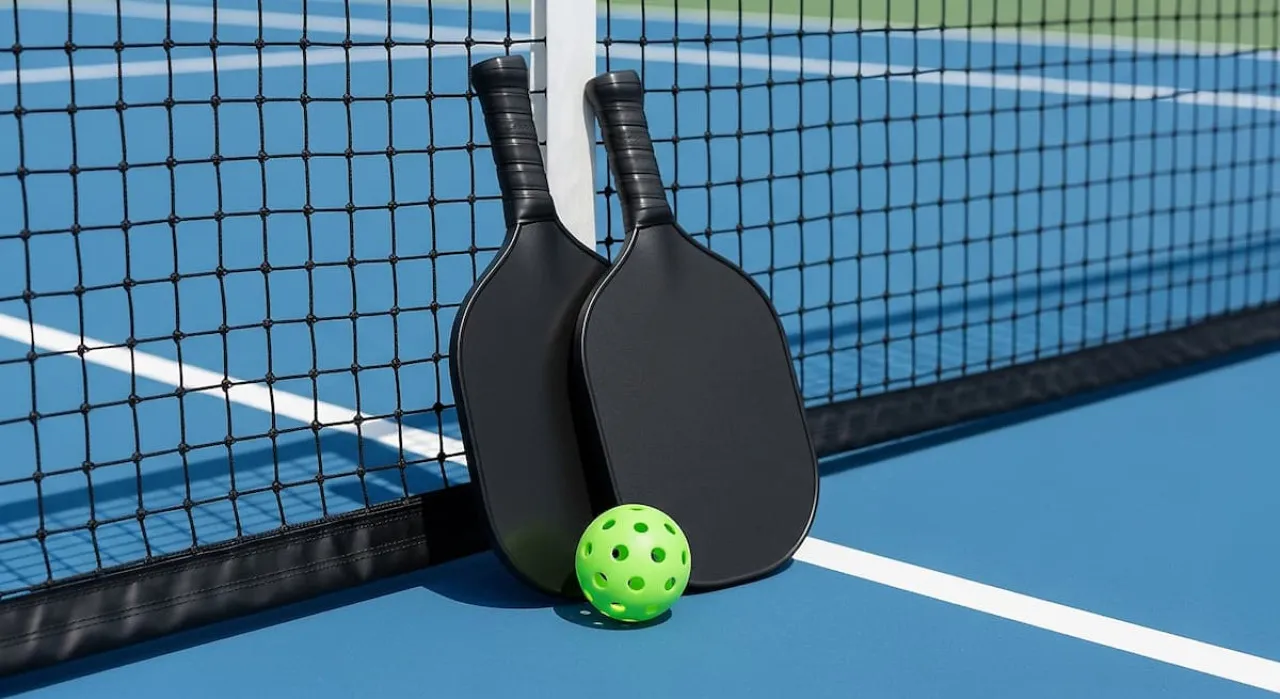
When planning pickleball court construction, understanding the court dimensions is crucial. In construction projects, the accuracy of pickleball court dimensions directly affects the court's overall quality and commercial value.
Therefore, ensure that you are familiar with the applicable official standards, from the length and width of the pickleball court to the height of the net and the details of the boundary lines. With proper planning, the construction process can run more efficiently, and the results will meet expectations.
So, how long is a pickleball court? Read this article to the end to get a complete and detailed guide!
Pickleball Rules
Before getting into the technical discussion of court dimensions, it is important to understand the basic rules of pickleball. This knowledge will help you adjust the court design to meet the game's needs. Here are some of the main rules you need to know:
1. Required Equipment
To play pickleball, you need a special ball with small holes and a paddle that is shorter than a tennis or badminton racket. The solid and compact design of the paddle helps players control the direction and power of their shots with greater precision.
Additionally, there are rules regarding the type of ball used in pickleball, depending on the playing environment. Balls for indoor pickleball games are generally lighter and have fewer holes. Conversely, outdoor pickleball balls are heavier to maintain stability in windy conditions.
2. Proper Serving Technique
The serve in pickleball is performed using an underhand technique, with the paddle striking the ball below the waist. Players start the serve from the right side of the court and direct the ball diagonally to the opponent's court.
It should be noted that the served ball must not fall in the opponent's non-volley area (kitchen). The order of service in pickleball starts with the player on the right side, then switches positions each time the team scores a point.
Read also: 7 Concrete Pipe Sizes, Their Functions, & Types
3. Scoring System
In pickleball, matches are generally played to 11 points. However, a win is only valid if the player or team is at least two points ahead of their opponent. This means that if the score is tied at 10–10, the game will continue until a two-point difference is achieved, for example, 12–10 or 13–11.
Points can only be scored by the team that is serving. If the serving team wins the rally, they will earn an additional point and continue serving. On the other hand, if they make a mistake, the serve will change to the opposing team without adding to the opponent's score.
4. Player Position Change
In singles pickleball, players change positions whenever a player scores a point while serving. Players will move from the right side to the left, or vice versa, depending on the points they have scored: even scores on the right, odd scores on the left.
Meanwhile, in doubles pickleball, the system is slightly different. Each team has two service opportunities before the turn passes to the opponent, except for the first serve at the start of the match. The serve remains aligned with the even or odd score. The server changes position when points are scored.
Official Standard Pickleball Court Dimensions
What are the standard dimensions of a pickleball court? According to regulations from the USA Pickleball Association, pickleball court dimensions are generally equivalent to those of a badminton court. The dimensions for both singles and doubles are the same, unlike in tennis.
In general, a pickleball court measures 13.41 meters (44 feet) in length and 6.10 meters (20 feet) in width. The court is then divided into several important areas, including:
- The right and left service boxes, used for diagonal serves.
- The non-volley zone (kitchen), which extends 2.13 meters from the net on both sides.
- The baseline, which marks the back boundary of the playing area.
- The sideline, which marks the width of the court.
For net height, official standards require 91.4 cm at the sidelines and 86.4 cm at the center. This height difference is regulated and must be applied to ensure the game runs in accordance with official rules.
In addition to the court's core dimensions, the free area surrounding it must also be considered, especially for tournaments or commercial facilities. Ideally, there should be at least 1.5–3 meters of additional space on each side. This space is important for supporting player movement, increasing safety, and maintaining comfort during the game.
Read also: Building Information Modeling: Definition & Its Features
Common Mistakes When Building a Pickleball Court
Building a pickleball court may seem simple, but several technical details are often overlooked. During construction, several mistakes often occur that can affect game quality and court durability. Here are some common mistakes you need to avoid:
1. Dimensions Not in Accordance with Standards
The most common mistake in construction is the inaccurate dimensions of the pickleball court. Even a difference of a few centimeters can affect the service angle, player reach, and game rhythm. If the dimensions do not meet official standards, the court also risks failing verification for tournaments or formal competitions.
2. Net Height Not in Compliance with Regulations
A net that is installed too high will make rallies more difficult, while a net that is too low can give certain players an unfair advantage. Differences in height between the center and the sides of the net must be measured accurately in accordance with regulations.
3. Uneven Court Surface
A wavy, cracked, or excessively sloped surface can significantly affect ball bounce. In addition to reducing game quality, this condition increases the risk of slips or injuries. Therefore, the casting, finishing, and final coating processes must be performed in accordance with technical standards.
This concludes the detailed explanation of official pickleball court dimensions, area specifications, and supporting regulations. By understanding each dimension, you can plan court construction in accordance with regulations and ensure it is comfortable for use by players of various skill levels.
During the construction, the accuracy of court measurements must be supported by high-quality materials to ensure the surface is strong, flat, and durable. Choosing the right cement is an important factor in ensuring the court's foundation does not crack easily and can withstand weather changes and intense use.
One solution to consider is the application of cement with advanced technology, such as Semen Merah Putih Watershield. Semen Merah Putih Watershield is equipped with water-repellent technology that provides extra protection from water, making it ideal for concrete slab casting, foundations, and pickleball court base layers.
Bring your pickleball court construction project to life with precision, strength, and usability for commercial or tournament needs using high-quality materials. Contact us now and consult with Semen Merah Putih about your construction needs!
Read also: Guide to Know the Deal House Height & How to Calculate It