
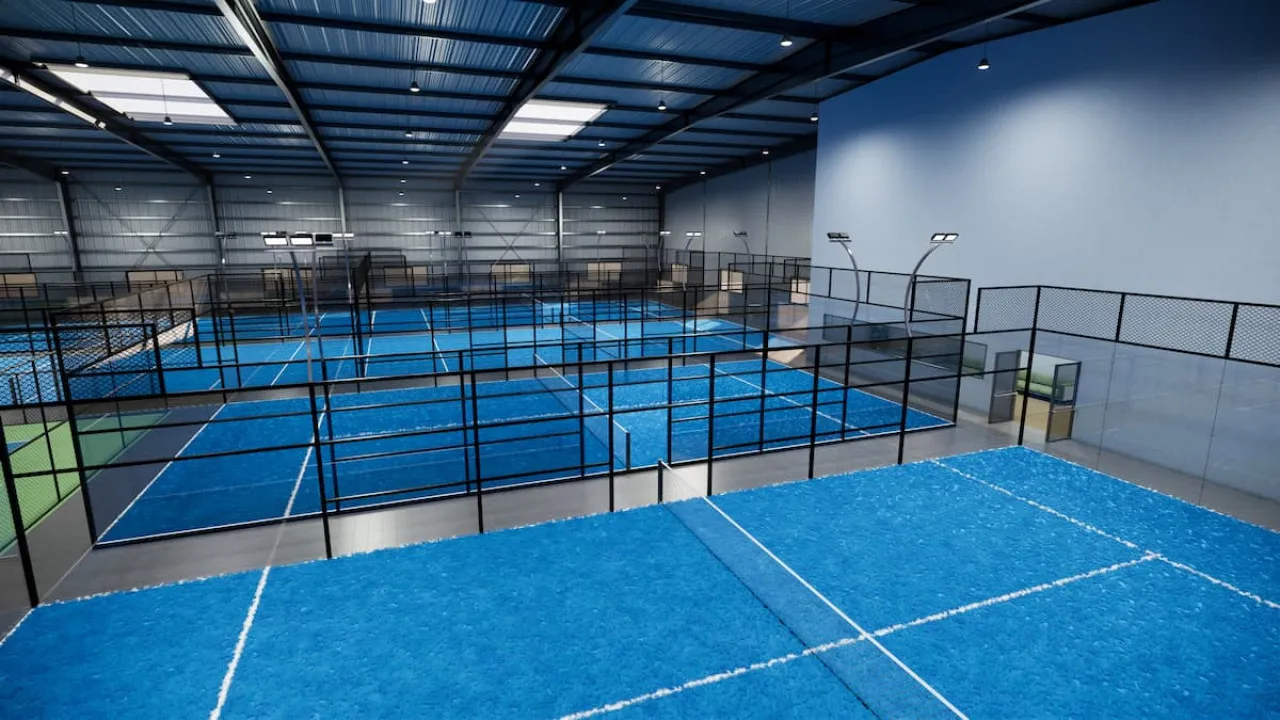
Padel courts are increasingly found in sports complexes, fitness centers, and commercial areas such as hotels and apartments.
At first glance, the court appears simple, but it actually has detailed specifications and requirements. Mistakes in construction, from determining the raw materials used to differences in court dimensions, can affect the game.
For anyone planning to build a padel court, whether for personal or commercial use, it is important to understand the standard dimensions and rules outlined in this article.
International Padel Court Dimensions (FIP)
Padel courts are rectangular and much smaller than tennis courts. However, because of their smaller size, precise specifications must be followed during construction.
Precise dimensions ensure fair play on both sides, as the distance for shots and players' movement space is balanced. Additionally, these standards help ensure consistent ball bounce off the glass walls, preventing unexpected situations.
From an operational standpoint, courts that adhere to FIP standards are generally easier to use for coaching, sparring, and even community tournaments. Furthermore, if you ever wish to upgrade the facility to a more professional level, a court that already meets the standards will help reduce future renovation costs.
To that end, ensure that every detail of the court you build complies with the International Padel Federation regulations for optimal ball bounce, player movement, and game strategy.
If you are looking for a clear reference on padel court dimensions, here is a guide that complies with FIP standards:
1. Court Length and Width
The standard international padel court measures 20 meters long and 10 meters wide. This size includes the main playing area. These dimensions are fixed and cannot be changed because they directly affect shot distance, game strategy, and player comfort during movement.
In this case, the court is divided into two equal parts by a net in the middle. Each side measures 10 x 10 meters. These dimensions make the game feel fast-paced because players are always relatively close to each other.
2. Service Area and Game Lines
Inside the court, there is a service line that runs parallel to the net. The distance between the service line and the net is 6.95 meters. The area between the net and the service line is called the front court, while the area behind it is called the back court.
The court also has a center line that divides the service area into two boxes. These lines are not just visual markers. The service must be placed precisely in the opponent's service box, so the accuracy of the line dimensions is very important for you to note.
In this case, the line width is generally around 5 cm, and the color must contrast with the court surface so it is easy to see.
Read also: GRC Wall Materials: Advantages, Disadvantages, and Types
3. Net Height
The padel net is installed at the center of the court, with a length matching the court's width of 10 meters. The net height in the middle is 88 cm, while at both ends it is 92 cm. This height difference causes the net to curve slightly downward in the middle.
The net must be made of a strong but flexible material, usually synthetic mesh. The net posts are installed outside the playing area to avoid interfering with player movement. Additionally, the top of the net must be covered with white tape with a maximum width of 2.5 inches (6.3 cm) for easy visibility.
The net height affects padel stroke techniques. If the net height does not meet the standard, the stroke direction and game strategy will change. Also, ensure the net is tightly stretched, not loose, as the ball's trajectory can be affected by the net's condition.
4. Glass Walls and Fences
The wall materials for a padel court must meet safety and durability standards. The glass used is generally tempered glass, approximately 10–12 mm thick. This type of glass is stronger and safer in case of impact.
For the fence, galvanized iron or steel coated with anti-rust paint is usually used. Meanwhile, the fence is designed with openings so the ball can still bounce consistently. All materials must be installed properly to ensure there are no gaps that could be dangerous for players.
5. Court Surface
Padel courts generally use synthetic turf specifically designed for sports. This material is chosen because it provides good traction for shoes, reduces the risk of slipping, and maintains a stable ball bounce.
The height of the synthetic grass fibers is usually between 10 and 15 mm, and they are filled with silica sand. This sand helps keep the grass upright while regulating the ball's speed. The color of the padel court surface is generally green or blue, but can be adjusted to suit the facility's concept.
Underneath the synthetic grass, there is usually a concrete base layer that must be completely flat. Even a few millimeters of unevenness can affect the ball's bounce direction.
Additionally, you also need to pay attention to drainage, especially for outdoor courts. Water should not pool as it will damage the synthetic grass layer and interfere with play.
6. Clearance Area
In addition to horizontal dimensions, you also need to consider vertical space. The minimum clearance height above the court is approximately 6 meters, and in professional competition, it can reach 8–12 meters.
This clearance area is important to ensure that high lob shots can still be played. If it is too low, the game will often be interrupted because the ball hits the ceiling or the building's structure.
7. Service Rules Related to Court Size
The size of the padel court is also directly related to the service rules. Serves must be made from behind the baseline, and the ball must bounce first in the opponent's service area before hitting the wall.
Padel serves are performed with an underhand stroke, in which the ball is hit after it bounces on the floor. A serve that directly hits the wall without first touching the floor is considered invalid. This rule makes padel easier for beginners to follow while remaining challenging for experienced players.
That is an explanation of the standard international padel court dimensions. By following FIP rules, padel courts can be used for competitions at various levels.
Not only that, but standard-compliant courts can also increase the value of the facility, especially if you intend to manage it professionally.
In addition to paying attention to court dimensions and standards, you must also ensure that each element is built with the right materials and good construction techniques.
High-quality materials will make the structure more stable, minimize cracks, and prevent structural deterioration.
For strong structural and foundation needs, you can use Precast Concrete from Semen Merah Putih. This product is designed to make buildings sturdier, neater, and more durable, ensuring your padel court remains safe and comfortable for long-term use.
If you would like more information about the most suitable materials for your construction project, please do not hesitate to contact us now.
Read also: High-Strength Concrete: Advantages, Manufacturing, & Uses