
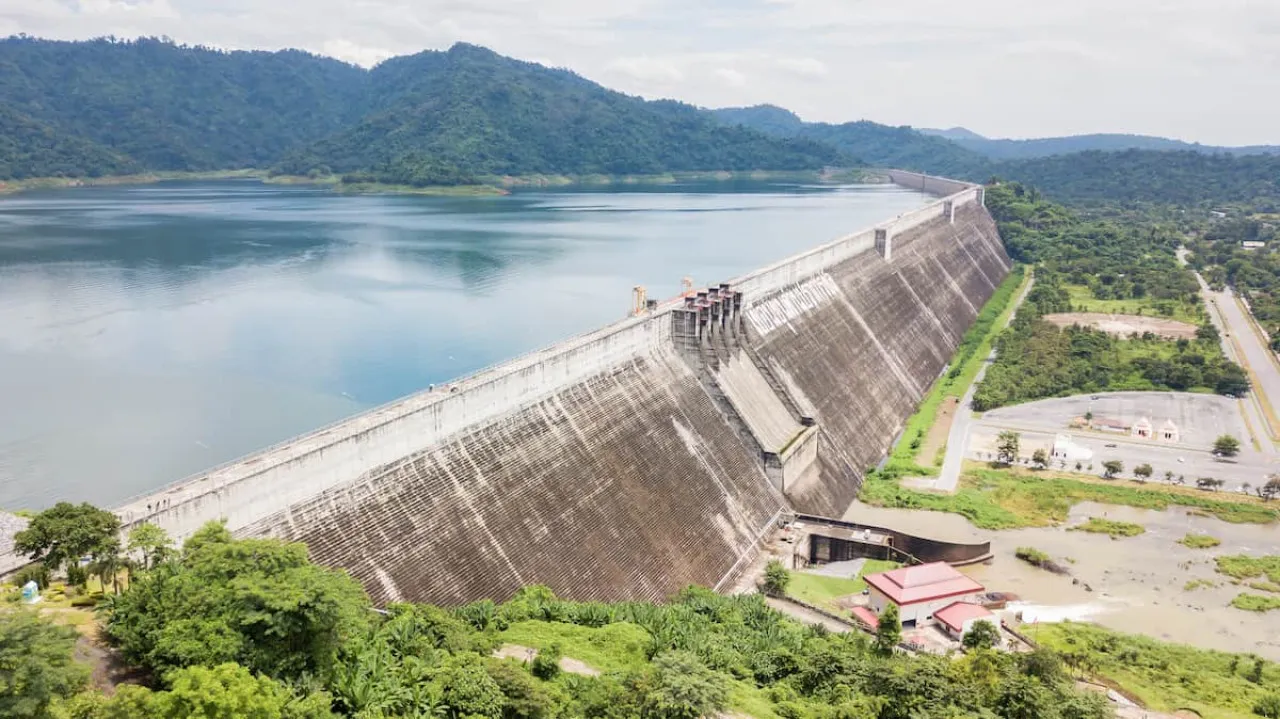
A dam is a large structure built across a river to hold back and regulate the water flow.
The structure of dams varies. For example, a gravity dam relies on its own weight, while an arch dam uses its curved shape to transfer pressure to the riverbanks.
All these designs involve detailed engineering calculations and construction technology support to ensure results that are stronger, safer, and more efficient for long-term use.
Want to know more about the different types of dam structures and their functions? Read this article until the end!
What Is a Dam?
A dam is a structure built to hold back or regulate the water flow, whether from rivers or groundwater.
By holding back water, dams help prevent flooding and regulate the water supply to ensure it is always available.
The water held by dams can be used for daily needs, such as drinking, agriculture, industry, and even fish farming.
Additionally, dams can also support hydroelectric power generation and help maintain environmental balance in the surrounding area.
Benefits of Dams
Dams have many benefits that directly impact daily life. Here are some important uses of dams:
1. Irrigation
Dams hold water from rivers or other sources and then channel it to rice fields and gardens through irrigation canals.
With this regulated water flow, the plants remain irrigated throughout the planting season, ensuring a more reliable harvest.
In areas with little or unpredictable rainfall, dams are an important water source for farmers, helping prevent drought and maximize the use of agricultural land.
2. Supplying Water for Consumption
Water stored in dams is usually still clean and can be used directly as drinking water for people in nearby cities.
Moreover, with good channels and canals, water from the dam can be directed to distant areas, meeting the water needs of many people.
Read also: Building Utilities: Definition, Systems, and Their Functions
3. Flood Risk Control
Dams can help reduce flood risks by holding back incoming rainwater before it flows rapidly into the river below.
The water held back can be released through the dam gates as needed, in a controlled manner. For example, the first flood control dam upstream was built in 1948, which is the Cloud Creek Dam in Oklahoma.
4. Generating Electricity
Hydroelectric Power Plants (PLTAs) use the energy of flowing water to generate electricity. The more water that flows, the greater the power that can be produced. Fast-flowing water turns the turbine, a device consisting of metal coils and magnets.
As the magnet spins over the metal coils, electricity is generated. Hydroelectric power plants produce clean electricity that does not cause pollution, making it suitable for meeting society's daily electricity needs.
5. Recreational Facilities
The dam holds back water, forming a reservoir behind it that can be used for various recreational activities.
At this reservoir, visitors can fish, boat, or try water sports such as rowing, canoeing, kayaking, and paddleboarding.
Additionally, the area around the reservoir is often used for camping, outdoor activities, or picnics, so the dam not only manages water but also serves as a place for entertainment and outdoor activities for society.
6. Transportation
Dams create waterways sufficient for transportation. Boats or small ships can cross reservoirs or dam-controlled water flows to transport goods and food more easily, making logistics distribution more efficient.
Purpose of Building Dams
Dams are built to support human life, but each dam usually has a specific purpose. For example, the Aswan Dam in Egypt was built to control flooding of the Nile River and to generate electricity.
In Indonesia, the Jatiluhur Dam in Purwakarta holds back the flow of the Citarum River while also providing electricity for society through a Hydroelectric Power Plant.
This dam is equipped with six turbines capable of generating up to 2.7 million kWh of electricity daily, so its function is not only as a water regulator but also as an important energy source.
Types of Dams Based on Their Structure
Dams have various designs, and each is determined by how the dam structure withstands water pressure. Here are the types of dams based on their structure.
1. Gravity Concrete Dam
This type of dam uses a structure made of very heavy concrete. The construction's strength relies on its own weight to withstand water pressure, making the structure very stable. This type of dam is suitable for construction in areas with solid, strong soil and rock.
Read also: Retaining Walls: Functions, Types, & Ideal Material Solutions
2. Arch Concrete Dam
An arch dam does not hold back water through its weight, but through its curved shape.
The water pressure is transferred to the canyon walls, allowing the structure to remain strong even with less material.
Because arch dams are flexible, they can be built in areas with soil or cliff conditions that are not very uniform.
3. Masonry Dam
This dam is constructed with a framework primarily of stones. The stones are arranged tightly and firmly to withstand the pressure of water.
To prevent water leakage, the central part of the dam is given a waterproof layer, such as concrete, asphalt, or clay. Since its main material is stone, this type of dam is ideally built in areas with abundant stone reserves nearby.
4. Earth Dam
An earth dam is formed from a mound of soil that is compacted and layered until dense. At the deepest part, there is a special waterproof layer to prevent water from leaking out.
Using readily available materials in the area, this type of dam is more economical and easier to construct across various soil conditions.
5. Membrane Dam
Membrane dams are a type of modern dam that has not been used for long. This dam utilizes a flexible layer made of rubber or vinyl as a water-retaining wall.
The layer is mounted on a sturdy support frame and works like a water shield that can follow shapes under pressure.
Its elastic nature makes it resistant to cracking, able to adjust to water pressure, and stable in controlling flow, without being as rigid as concrete dam structures.
That is a summary of information about dams, from a basic overview to classifications based on the dam structures that compose them.
By understanding each type and its structural characteristics, you can see that dam design is not just about holding back water, but also about durability, functionality, and suitability to the environmental conditions where it is built.
The choice of materials is a key determinant of a dam's strength and resilience. Dams built with high-quality materials will be more stable, able to withstand water pressure consistently, and have a longer service life.
Therefore, it is important to choose materials specifically designed to support the dam's structure, such as products from Beton Merah Putih, a brand of Semen Merah Putih.
Beton Merah Putih provides various construction needs, including Ready Mix Concrete, Precast Concrete, and supporting aggregates, all produced under strict production standards.
This material is suitable for the construction of large-scale dams that require extra durability, optimal density, and reliable long-term performance.
If you are looking for quality materials or need technical guidance, Beton Merah Putih could be the right choice.
With the use of appropriate and quality-assured materials, dam structures can be built stronger, safer, and more prepared to withstand various environmental conditions.
If you need more information, technical assistance, or recommendations for the best materials, contact us immediately. Build stronger and more durable dams with Beton Merah Putih whenever you are ready!
Read also: 15 Types of Raw Materials for Building and What They Do