
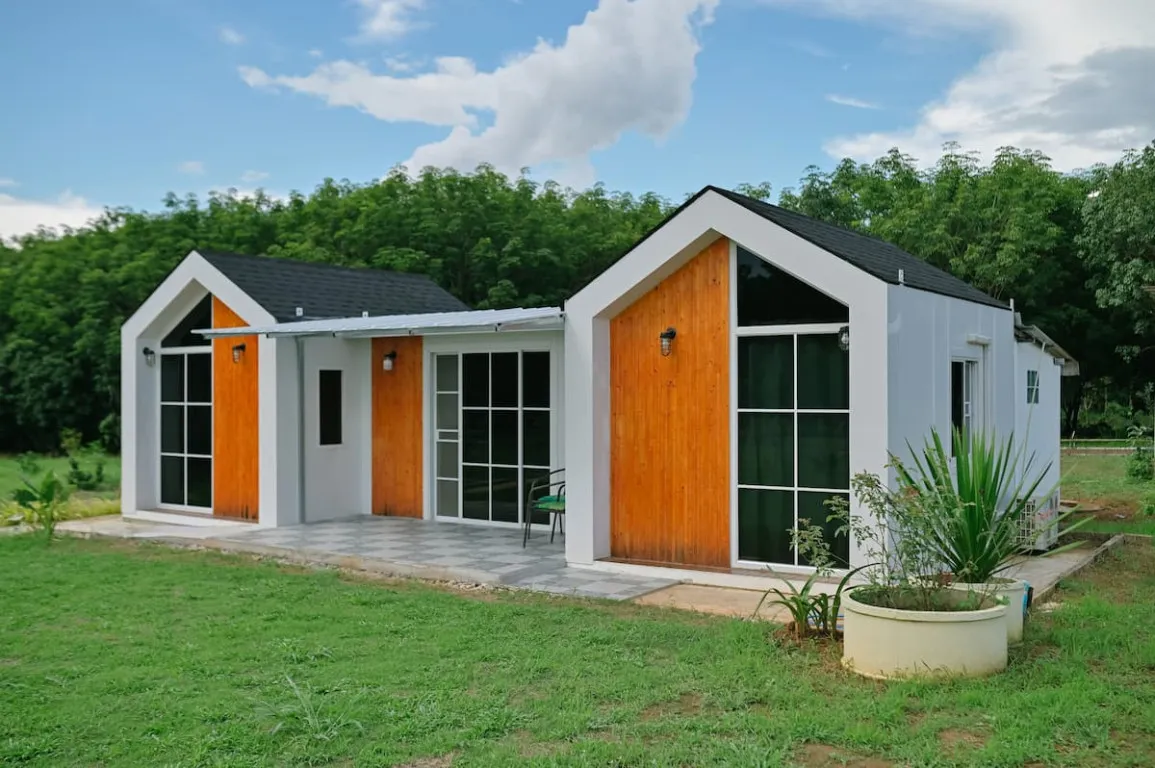
For those seeking alternative housing, prefabricated houses can be a viable option. These houses are often referred to as prefabricated houses, which are dwellings made from factory-manufactured components that are ready to install and assembled on site. The process is more concise, allowing construction, from the foundation of the house to other parts, to run faster and more efficiently.
Although not yet widely used, prefabricated houses have their own appeal because they are practical and produce relatively neat results. If you are curious and want to understand the concept and advantages of manufactured houses in a more relaxed and comprehensive manner, read this article to learn more about prefabricated houses.
What Is a Prefabricated House?
A prefabricated house is a type of house that is not built on-site. The parts of the house are produced in advance at the factory, then sent to the site for installation and assembly. This method simplifies the construction process and makes it more organized.
This is different from conventional houses, which are built gradually on site, starting from arranging the materials to assembling the structure piece by piece. In prefabricated houses, most of the heavy work is already completed at the factory.
Even though they are made to certain standards, the design of prefabricated houses does not mean that they are all the same. Their appearance can resemble ordinary houses or even feature a modern style, according to your needs.
Is It More Affordable to Build a Regular House or a Prefabricated House?
Many people are considering prefabricated houses because they are considered more affordable than regular houses. This is possible because the manufacturing process is different from the outset.
Most of the construction process is carried out in a factory. With this system, work can proceed more quickly because the necessary tools are available and activities are not disrupted by rain or heat. The organized workflow also helps reduce the risk of construction delays.
On the other hand, factories produce houses on a large scale. Materials are purchased in bulk, which helps reduce costs. It is this combination of efficient processes and cost management that often makes prefabricated houses generally more affordable.
Read also: Earthquake-Resistant House: The Features & How to Build It
Advantages of Prefabricated Houses Compared to Conventional Houses
Prefabricated houses are known not only for their practical construction process but also for various advantages that are difficult to find in conventional houses. To understand the advantages of prefabricated houses compared to conventional houses, here are some important points to consider:
1. Cost-Friendly for Long-Term Use
The cost of building a prefabricated house is typically more economical than that of a conventional house. This is because the house parts are manufactured in a factory, thus allowing for more controlled use of materials and less waste.
The construction time is also shorter, so labor costs can be reduced. With the same budget, you can get a house with better construction quality and amenities.
2. Fast Construction Process
One of the main advantages of prefabricated houses is the fast construction process. The parts of the house are already manufactured in the factory, so on-site work is only assembly and does not take as long as the construction of a typical concrete house.
Once the assembly process is complete, prefabricated houses can be occupied immediately. This is ideal for those who need housing for a limited time, such as for urgent needs or to build homes in remote areas.
3. Guaranteed and Consistent Quality
Prefabricated houses are made through a more organized process because all parts are manufactured in a factory. The stable working environment gives proper supervision of material selection and the manufacturing process. Each component is assembled using accurate calculations to ensure a neat, compliant final result.
With this system, the potential for errors during construction can be minimized. Unlike conventional houses, which are built on site and are subject to technical constraints, prefabricated houses offer more consistent build quality from the start of the manufacturing process.
4. Environmentally Friendly
Prefabricated houses are often considered more environmentally friendly because their manufacturing processes are more organized. Materials are carefully measured at the factory, thereby minimizing waste.
Additionally, many prefabricated houses use safer, environmentally friendly materials, such as recycled materials or lightweight steel. Therefore, this type of house is a more environmentally conscious housing option.
5. Flexible Design and Easy to Modify
Prefabricated houses are designed to adapt easily to occupants’ needs. From the building's size to the layout of the rooms, everything can be arranged according to your preferences from the outset. You can also add certain features without changing the entire structure.
Another advantage is that prefabricated houses are not rigid. If you want to move, expand, or change the function of a room in the future, the process is relatively simple. This is what makes prefabricated houses suitable for those who need a house that can evolve.
6. Minimal Disturbance at the Construction Site
Conventional house construction often causes noise, dust, and heavy equipment activity around the site. These conditions can disturb the surrounding environment.
Unlike prefabricated houses, most of the construction process is carried out in a factory. When installed on site, the process is shorter and neater. Therefore, disturbance to the surrounding environment can be minimized, and the atmosphere remains more comfortable.
7. Resistant to Extreme Weather and Corrosion
Prefabricated houses are constructed with strong materials that are resistant to various weather conditions, including heavy rain, strong winds, and intense heat. Selecting these materials helps reduce the risk of damage or rust to the building.
Additionally, some prefabricated houses are equipped with heat insulation. This feature keeps the house comfortable, whether the weather is hot or cool.
Read also: Type 36 House Area: A Cozy & Functional Living Solution
Disadvantages of Prefabricated Houses
Despite their many advantages, prefabricated houses still have some limitations that need to be considered. Here are some important disadvantages of prefabricated houses to be aware of:
1. Land Costs
One of the disadvantages of prefabricated houses is that you still need to prepare your own land. These houses do not automatically come with the land, which means you have to buy or rent land to build them on. This needs to be taken into account from the outset, as land costs can be an additional expense.
2. Potential Quality Issues
Basically, prefabricated houses are designed to be built faster and at a lower cost, though there are limited design customization options. For some people, these limitations are acceptable because their main focus is on practicality and price.
However, in some cases, the construction process can experience delays or building quality problems. If this happens, you will need to incur additional repair costs before the house can be occupied. This situation means that the expected cost savings are not maximized.
3. Negative Image
Prefabricated houses are still often viewed negatively by some people. Although this view is beginning to change, the negative impression sometimes makes you hesitate or not interested in choosing them.
In fact, the decision to choose a prefabricated house depends on your individual needs and circumstances. Despite their limitations, prefabricated houses remain attractive because they tend to be more affordable than other types of houses.
4. Limited Options
Prefabricated houses offer fewer customization options. Given that the entire design and manufacturing process is carried out in a factory, design changes are usually not permitted.
If you want to make special adjustments, the process can take longer. Even so, there are generally several layout options available that can be tailored to residents' basic needs.
How to Arrange the Interior of a Prefabricated House
After considering the advantages and disadvantages, you may still be interested in owning a prefabricated house. To make your home comfortable and visually appealing, you need to pay close attention to the interior design. Here are some tips you can apply:
- Combine 2–3 patterns and colors to prevent the room from looking monotonous and make it feel more lively.
- Add indoor plants to give a fresh impression. If space is limited, utilize wall shelves or vertical gardens.
- Use small wall decorations, such as paintings, to create the impression of a more spacious room.
- Arrange furniture away from walls to make the room feel more spacious and less cluttered.
- Choose functional decorations, such as rugs, mirrors, or paintings, without adding too much furniture.
With the right layout, the interior of a prefabricated house can remain comfortable, neat, and attractive to live in.
That concludes the information on prefabricated houses, from their definition to how to arrange their interiors. If properly planned, prefabricated houses can be a practical, comfortable, and attractive long-term housing option.
Building a house, regardless of its type, still requires thorough planning to ensure a comfortable, durable result. The selection of appropriate materials must be considered to ensure that every part of the building functions properly and does not cause problems in the future.
Besides attractive designs, structural strength is also an important factor in ensuring that houses remain sturdy and durable in the long term. To support this, you can use high-quality materials from Semen Merah Putih, one of which is Semen Merah Putih Watershield.
Semen Merah Putih Watershield is equipped with water-repellent technology that protects against water seepage from the outside, inside, or the ground, helping reduce moisture. With the right materials, buildings not only look neat and modern but are also stronger and better protected.
Contact us now for more information about Semen Merah Putih products and consult your house construction needs!
Read also: 13 Comfortable and Aesthetic Space Planning Ideas