
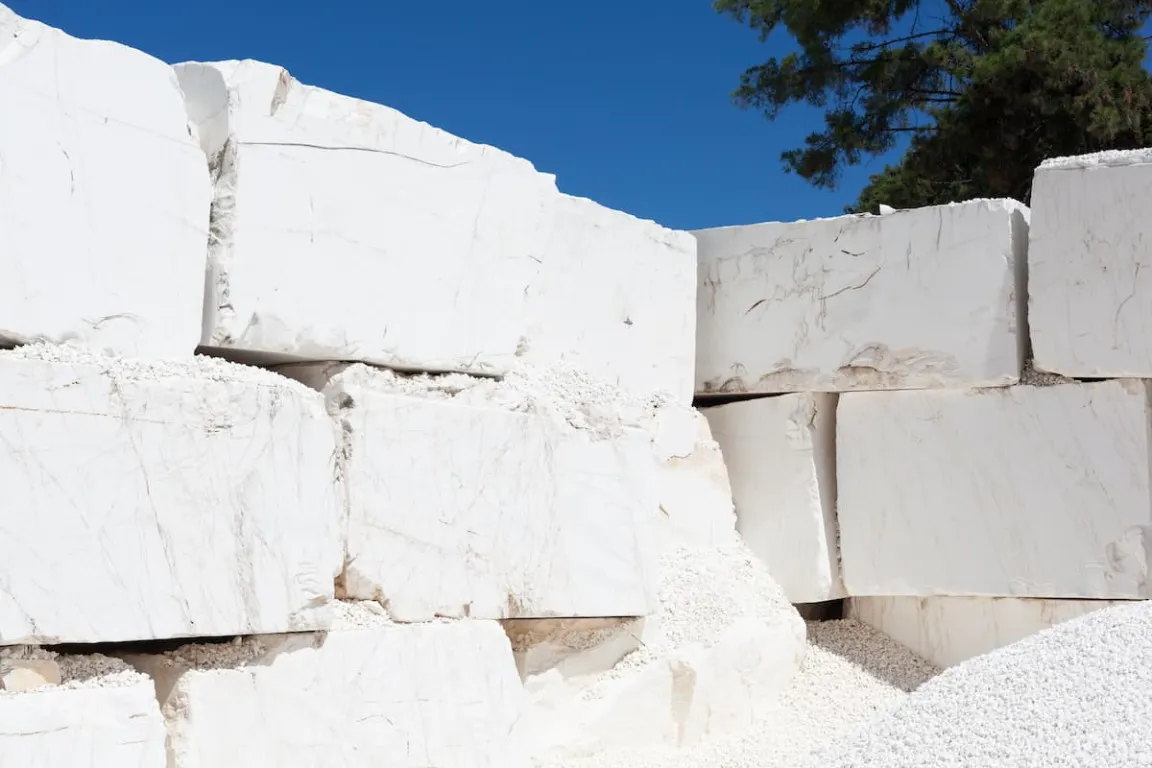
High housing demand has made limestone foundation an increasingly popular alternative to bricks. This natural stone from Tuban, which resembles lightweight bricks, offers a cost-effective, sturdy, and easy-to-install construction solution that ensures long-term stability.
Curious about its performance and the proper installation guidelines? Read the full overview below to avoid making the wrong choice when selecting materials for your dream home!
What Is Limestone Foundation?
Limestone foundation is a white sedimentary limestone (partly dolomite) mined in the hills of several East Java regions, including Tuban, Lamongan, Bojonegoro, and Madura.
This carbonate-based material (calcite CaCO₃, partly dolomite CaMg(CO₃)₂) is typically cut into blocks, such as 24×25×48 cm or 30×30×30 cm, specifically designed to support the structural load of a building’s foundation.
With its rough surface texture, this stone bonds well with mortar. Compared with red bricks or concrete blocks, limestone has far superior compressive, tensile, and shear strength, making it ideal for use in high-moisture soil.
Although its strength is still lower than river stone, this environmentally friendly material offers a reliable alternative for creating sturdy, efficient building foundations.
The Function of Limestone Foundation in Building Construction
In construction projects, a limestone foundation provides reliable structural support, even on wet or high-rainfall land, provided the foundation is properly designed. Its rough surface texture allows cement mortar and aggregate to adhere strongly, helping maintain building stability even on unstable ground when designed correctly.
In addition to providing primary support at the base, its high compressive strength also makes it safe for load-bearing walls, including in multi-story buildings, with appropriate structural calculations.
Furthermore, its unique natural appearance is often utilized as a decorative element in fences and exposed walls with a “raw” aesthetic. However, its use still requires technical calculations and expert supervision to ensure maximum structural support.
Read also: Building Structures: Types, Elements, and Examples
Advantages of Limestone Foundation
Limestone has several characteristics that make it widely used as a foundation material, including:
- Sturdy and strong: Limestone has a compressive strength of approximately 22.5–32.5 kg/cm², higher than bricks, which range around 11.2 kg/cm².
- Easier to install: Its relatively large size speeds installation, saving time and labor.
- Bonds well with cement: Limestone bonds well with cement, creating a strong, integrated foundation.
- Relatively affordable: Its affordable price makes limestone a popular choice for foundation materials.
- Fairly versatile: Beyond foundations, limestone can be used for retaining walls, gardens, housing, and various outdoor structures.
Disadvantages of Limestone Foundation
Despite its advantages, limestone also has several considerations that should be considered before using it as a foundation material, such as:
- Irregular sizes: Variations in shape and size can make the installation process more difficult and result in a less neat finish.
- Requires experienced workers: Experts should install it to ensure a neat, sturdy stone arrangement.
- Limited availability in certain areas: Limestone isn't always easy to find everywhere, so you may need to order it online from other areas.
How to Install Limestone Foundation
Install limestone foundations in stages to ensure a sturdy, stable arrangement. Here are the general steps:
1. Determine the Foundation Location
Determine the foundation’s position based on the building’s design and soil conditions. Ensure the location can support the foundation’s load.
2. Clear and Level the Ground
Remove soil, rocks, roots, and other obstructions. Then level the surface and ensure the ground isn't too wet.
Read also: 10+ Types of House Building Materials & How to Choose Them
3. Dig the Foundation Area
Dig the foundation pit according to the specified dimensions. Adjust the depth and width to accommodate the foundation stones while ensuring the foundation’s stability.
4. Arrange the Foundation Stones
Place the foundation stones into the excavation and arrange them tightly. Position them so that the foundation surface remains level and stable.
5. Compact the Stone Arrangement
Use a hammer to adjust the stones so they fit more tightly together. Ensure the stones are in contact to prevent the foundation from shifting easily.
6. Fill Gaps and Compact
Fill the gaps between the stones with sand or gravel to fill any empty spaces. Afterward, compact the mixture using appropriate tools to strengthen the foundation.
7. Use Formwork if Necessary
If needed, install formwork or scaffolding to maintain the foundation's shape and position during construction.
Once the foundation is complete, construction can proceed according to the design and applicable construction standards. Ensure that each stage of the work complies with local building codes.
Is Limestone Safe for Foundation?
Limestone is considered safe for foundations because its compressive, tensile, and shear strength has been proven to exceed that of red brick and concrete blocks. However, the structural reliability still depends on stone quality, excavation depth, and building design.
To ensure long-term durability, technical planning must consider soil conditions and structural loads. Therefore, consult a geotechnical expert or civil engineer to ensure your material choices and foundation design comply with local safety standards.
Choosing limestone as the building’s foundation is a safe, efficient choice. However, a building’s durability depends on more than the foundation material alone. To keep the structure sturdy and prevent long-term damage, high-quality binding materials also play a crucial role.
To maximize building strength, trust Semen Merah Putih Watershield. This super-premium, multipurpose cement uses water-repellent technology to provide triple-layer protection that blocks water seepage from the outside, inside, and absorption into the soil.
As a result, your building becomes significantly stronger, more durable, more resistant to extreme weather, and requires minimal maintenance. These benefits apply to every part of construction, from foundations, concrete slabs, cast-in-place concrete, and masonry to plastering and rendering.
Want your dream house project to run smoothly with maximum results? Contact us now for a consultation and get the best construction material solutions!
Read also: 15 Types of Raw Materials for Building and What They Do