
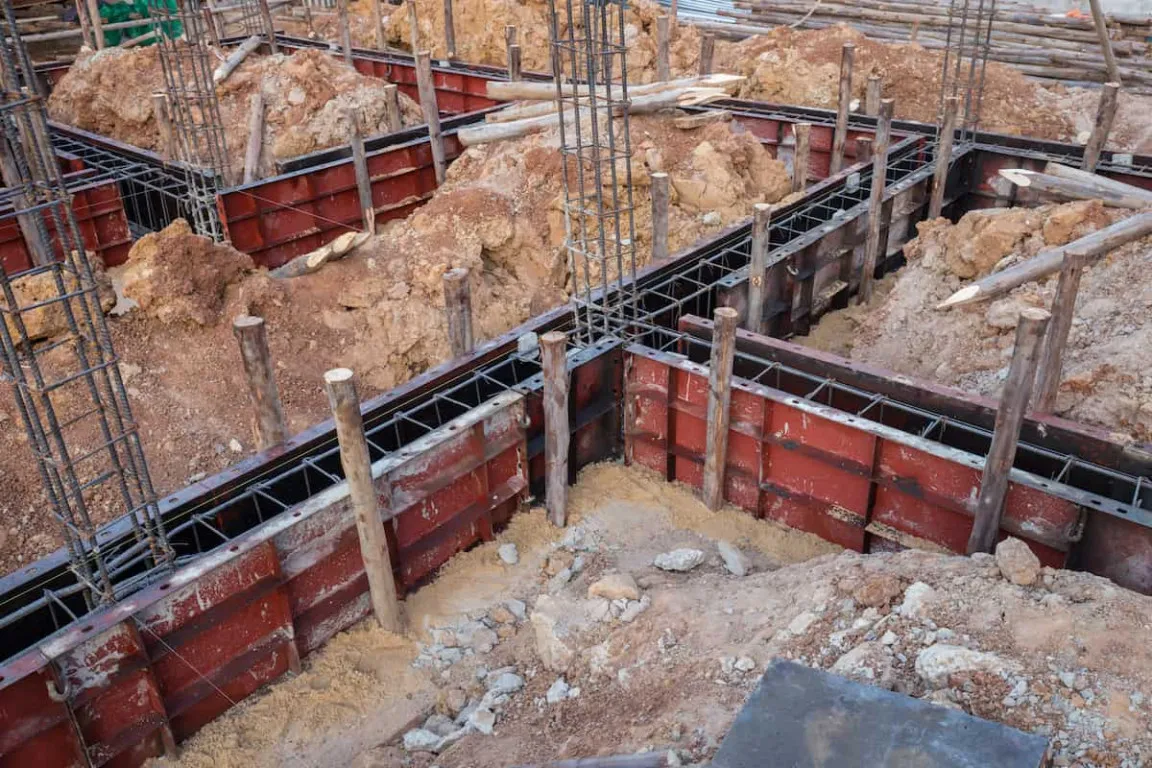
In construction, proper planning and calculations are crucial for determining a building's strength and stability.
One essential element of the foundation is the ground beam, which supports and distributes the load from the columns above while connecting the building's pillars.
The ground beam is part of the upper structure, located directly above the foundation, so its steel requirements must be calculated meticulously.
Several factors affect these calculations, including the size of the ground beams, the load weight they support, and the desired technical specifications.
So, how do you calculate the ground beam reinforcement requirements correctly? Read this article to the end to find out the answer.
What Are Ground Beams?
Ground beams are structural elements in a building, typically located above the foundation. Its function is to distribute the foundation load and secure the walls in place, keeping them sturdy and preventing them from collapsing or cracking due to soil movement.
The location of the sloof depends on its function. If the sloof connects two foundations and distributes the load, it is positioned at the foundation level.
However, if the ground beam serves as a levelling beam supporting walls or columns, it is positioned closer to the building surface.
The size of the ground beam reinforcement is determined by construction requirements. Obviously, the size of a ground beam for a two-story house will be different from that of a one-story house. Therefore, the calculations must be done accurately.
Types of Ground Beams
Ground beams play a role beyond simply supporting buildings. Their shapes and materials vary based on construction requirements.
Each type of ground beam has its own characteristics and advantages for maintaining the structural integrity of buildings. Here is a detailed explanation:
1. Reinforced Concrete Ground Beam
Reinforced concrete ground beams are typically used in single-story houses with stone foundations. So, what is the size of a reinforced concrete ground beam? It is approximately 15–20 cm high.
In addition to supporting the foundation, this ground beam also serves as a beam that binds the foundation pillars, keeping the building structure sturdy and stable.
2. Brick Ground Beam
Brick ground beams are not strong enough to serve as the primary load-bearing structure for a house because they readily absorb water and become damp. This condition can cause the walls or foundation to slowly crack or shift.
Therefore, brick ground beams are typically used for light buildings or as supplemental foundations, not as the primary foundation for heavy loads.
Read also: Simple Guide to Calculating the Area of A 2-Story Building
3. Wooden Ground Beams
Wooden ground beams are typically used in stilt houses that stand on wooden poles. Their function is to bind the foundation poles together, keeping them sturdy and stabilising the entire building.
With wooden ground beams, stilt houses can stand more firmly, even though they are on poles, making their structure safer and more durable.
How to Calculate Ground Beam Reinforcement Requirements
Calculating ground beam reinforcement requirements is a crucial step in ensuring that a building remains strong and safe. This process involves several calculations, from determining the size and type of the ground beam to applying a safety factor to account for additional loads.
By following the correct steps, ground beams can function optimally as supports for foundations and columns. Here is how to calculate ground beam reinforcement requirements:
1. Determine the Size and Type of Ground Beam
Check the size and type of ground beam to be used in construction, as these factors determine the building's strength and stability.
For example, the size of a single-story house's ground beam is set at 15 cm x 20 cm, which is known to be sufficient to support the foundation and columns.
2. Calculate the Total Length of the Ground Beam
The next step in calculating the ground beam reinforcement is to determine the ground beam's total length. This length is calculated from the building plan and construction plan, including all sides and joints of the ground beam to be installed.
3. Calculate the Number of Main Reinforcing Bars
Note the number of main reinforcing bars required for the sloof. These reinforcing bars serve to support the load and maintain the structure's strength. After determining the number of bars, multiply it by the total length of the ground beam according to the building plan.
4. Calculate the Number of Stirrups
Next, calculate how many stirrups are needed by considering the total length of the ground beam and the distance between stirrups.
Stirrups are used to bind reinforcing bars, allowing they remain in position. Ensure calculations are accurate to ensure the ground beam is strong and the required steel quantity aligns with the construction plan.
5. Calculating the Length of One Stirrup
Next, determine the length of one stirrup. This length will be used to calculate the total length of all required stirrups. This step will help you determine the steel quantity for the entire ground beam.
6. Calculating the Stirrups
To find out the total amount of stirrups needed, multiply the number of stirrups by the length of one stirrup. From this calculation, you will determine the amount of steel required to install the ground beam correctly.
Read also: Building Utilities: Definition, Systems, and Their Functions
7. Calculating the Number of Steel Bars
The next step is to calculate the number of steel bars required. To do this, divide the total length of rebar required by the length of one bar of rebar. This will give you the amount of rebar that must be prepared.
8. Add a Safety Margin
The final step is to add about 3%–5% of the total rebar as a reserve. This is done to anticipate a potential rebar shortage during installation, so the ground beam remains safe and on schedule.
Example of How to Calculate Ground Beam Requirements
Imagine you want to make a foundation ground beam to support the walls of a house. This ground beam measures 15 cm × 20 cm × 4 m (length × width × height), and the walls to be supported have a total weight of around 10 tons. Here's how to calculate the iron requirements:
Ground Beam Volume
Calculate the volume of the ground beam by multiplying the length, width, and height:
0.15 m × 0.20 m × 4 m = 0.12 m³
Wall Load
Total wall load = 10 tons or 10,000 kg
Reinforcement Bars
Use reinforcement bars with a diameter of 10 mm. These main reinforcement bars will be reinforced with stirrups, typically 8 mm in diameter, to ensure the frame remains stable.
Reinforcement Steel Requirements
Construction standards typically recommend a minimum reinforcement ratio of 0.2%–1% of the concrete cross-sectional area.
Reinforcement steel cross-sectional area = 0.15 m × 0.20 m = 0.03 m²
If a reinforcement ratio of 0.75% is used, the calculation for the main reinforcement bars is as follows:
One bar area of reinforcement with a diameter of 10 mm = π × (0.01²) / 4 = 7.85 × 10⁻⁵ m²
Number of main bars = 0.000225 / 0.0000785 ≈ 3 bars
From these calculations, it can be concluded that approximately 4 bars of 10 mm diameter reinforcement steel should be prepared.
Weight of Stirrups
Stirrups are fasteners used to maintain frame shape and resist shear.
In this scenario, the stirrups used are 8 mm in diameter with dimensions of 10 cm × 15 cm and a distance of 15 cm between stirrups.
Number of stirrups = 4 m / 0.15 m = 26.6 ≈ 27 pieces
Length of one stirrup = (2 × 0.1) + (2 × 0.15) + 0.24 (hook) = 0.74 m
Total length of stirrups = 27 × 0.74 = 19.98 m ≈ 20 m
Number of stirrup bars = 20 / 12 = 1.67 bars ≈ 2 bars of 8 mm diameter stirrups
Weight of Reinforcement Steel
Calculate the weight of the reinforcement steel by including the density factor of steel (≈7850 kg/m³) in the following formula:
π × d2 × ρ / 4
= 3.1416 × (0.01)2 × 7,850 / 4
= 0.6167 kg/m
The weight of the 4 steel bars required is 16 m × 0.6167 kg/m, totaling 9.87 kg.
Meanwhile, the weight of the stirrups is the result of multiplying the total length of the stirrups by their specific weight, which is 0.395 kg/mm.
Weight of stirrup reinforcement = 20 m × 0.395 = 7.9 kg
The total weight of the reinforcing bars and stirrups is 17.77 kg. For safety, add approximately 5% (1.05) for cuts and joints. The calculation is as follows:
17.77 kg × 1.05 = 18.66 kg
Rounded up, a total of 19 kg of reinforcing steel is needed for a 15 cm × 20 cm × 4 m sloof.
That concludes the explanation of ground beams, from their definition to how to calculate the amount of steel required for them.
By understanding the ground beams and their calculations, you can ensure that the foundation and walls of your house are stronger and more durable.
The use of appropriate materials, especially for concrete ground beams, significantly affects a building's strength and durability.
For this reason, use high-quality materials from Beton Merah Putih, a subsidiary of Semen Merah Putih, to ensure the concrete ground beams support the structure firmly and durably.
Beton Merah Putih offers a variety of products, including Ready-Mix Concrete, Precast Concrete, and aggregates, specifically designed to meet the needs of modern construction.
Whether for residential or large-scale projects, all Beton Merah Putih products are designed to be strong, durable, and meet the quality standards.
Contact us for consultation and further information about the best concrete products. Realise your dream building with sturdy ground beam reinforcement and high-quality materials from Beton Merah Putih.
Read also: The House Foundation Cost Estimation Details in 2025