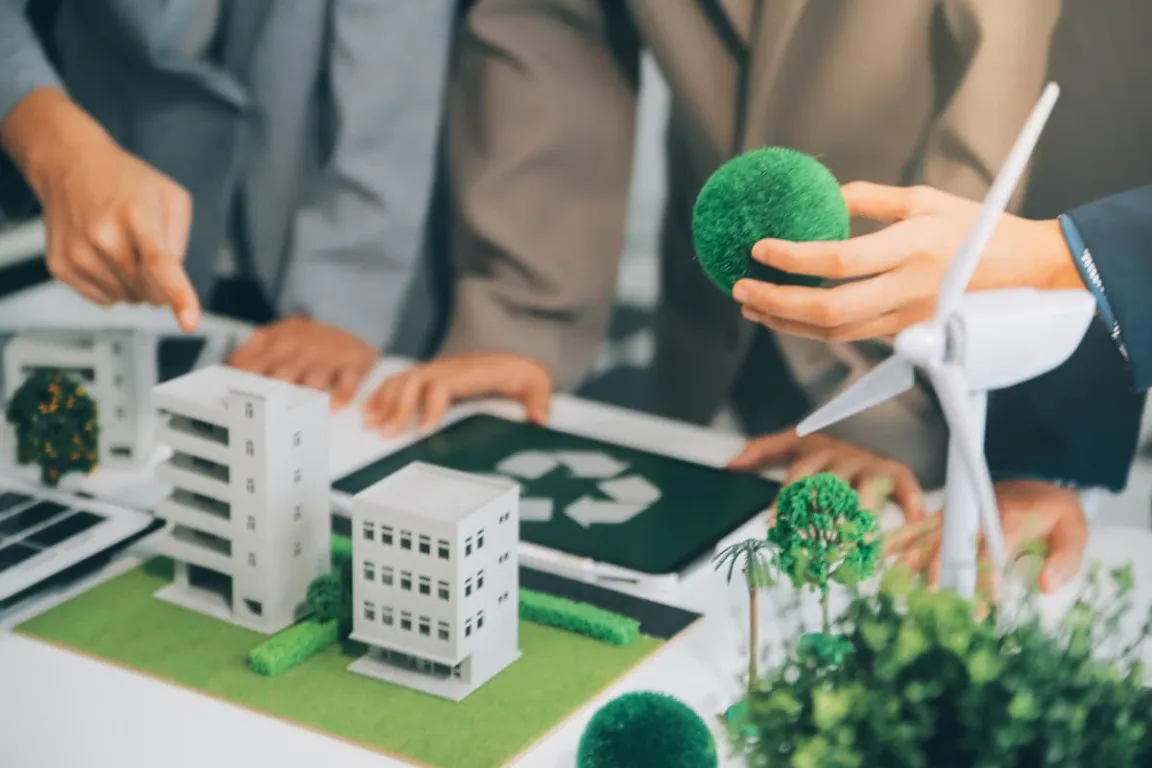
Green building certification has become an important standard in the construction industry as attention to sustainable buildings grows. Through this certification, companies can demonstrate their commitment to the environment while supporting operational efficiency.
In Indonesia, green building certification also helps evaluate a building’s environmental and sustainability performance, including the Greenship system developed by the Green Building Council of Indonesia (GBCI).
So, what is the certification process like, and what are some examples of its implementation? Read the full explanation in this article.
What Is Green Building Certification?
Green building certification is an official recognition for buildings that meet environmentally friendly and sustainable construction standards.
This certification evaluates various aspects, such as energy efficiency, water management, use of sustainable building materials, carbon emissions reduction, and occupant health and comfort.
With this certification, buildings are expected to reduce their environmental impact while implementing best practices throughout the design, construction, and operational phases.
In Indonesia, the Green Building Council Indonesia (GBCI) grants green building certification through the Greenship system, which is tailored to local conditions.
In addition, commonly used international certification standards include EDGE (Excellence in Design for Greater Efficiencies), LEED (Leadership in Energy and Environmental Design), and Green Mark.
Each has different assessment criteria, but they all aim to promote more environmentally friendly and sustainable development.
Read also: The Concept and the Future Benefits of Green Architecture
Green Building Certification Assessment in Indonesia
Under the Greenship system, the Green Building Council Indonesia (GBCI) has established six main criteria as the basis for green building certification assessment. Each criterion focuses on sustainability aspects that must be implemented from the construction process through building management. Take a look at the six assessment criteria below:
1. Appropriate Site Development
The Appropriate Site Development (ASD) criterion focuses on sustainable land use. One way to implement this is by not using the entire area for the building itself.
Designate 30% of the land as green open space and water absorption areas to maintain environmental balance.
2. Energy Efficiency and Conservation
This criterion emphasizes energy efficiency during both the construction and operational phases of a building.
This can be achieved by monitoring electricity consumption, optimizing natural lighting, using artificial lighting efficiently, adjusting air conditioning use as needed, reducing heat gain through the building envelope, and minimizing the use of non-renewable energy.
3. Water Conservation
In the Water Conservation category, the assessment focuses on efforts to conserve and manage water use to prevent waste. Implementation includes monitoring water consumption, using rainwater as an alternative source, and managing wastewater during construction.
4. Material Resources and Cycle
The Material Resources and Cycle criteria assess how building materials are managed sustainably. Leftover materials should be reused, while materials that can no longer be used must be disposed of in a more environmentally friendly manner.
5. Indoor Health and Comfort
The Indoor Health and Comfort aspect aims to create a healthy, comfortable environment for occupants, as this can affect productivity.
Measures include maximizing natural light, reducing artificial lighting during the day, preventing visual disturbances from improper lighting, muffling external noise, and minimizing indoor air pollution from interior materials.
Read also: Building Utilities: Definition, Systems, and Their Functions
6. Building Environment Management
The final criterion is Building Environment Management, which focuses on the sustainable management of buildings. Its scope includes waste management, educating occupants about environmentally friendly practices, and maintaining building systems to ensure they continue to function properly.
If a building meets these criteria, it can obtain green building certification as proof that it has implemented environmentally friendly and sustainable construction principles.
The Green Building Certification Process in Indonesia
To obtain Greenship certification in Indonesia, project owners must go through the following steps:
- Setting certification goals: The process begins during the planning stage by setting the goal of obtaining green building certification. Next, the Green Building Council Indonesia (GBCI) team conducts an initial visit to explain the certification process.
- Appointing a Greenship Professional (GP): The project owner then appoints a Greenship Professional to assist throughout the certification process.
- Submitting the application: Next, the project owner completes a letter of intent and pays an initial donation of Rp5,000,000.
- Completing required documentation: GBCI will provide a registration form that must be accompanied by eligibility documents, such as the RTRW (Regional Spatial Plan), UKL-UPL (Environmental Management and Monitoring Plan), and proof of a minimum building area of 2,500 m².
- Verification and contract: If the documents are deemed eligible, the project owner signs the contract and pays 25% of the certification fee.
- Project registration: Once the administrative process is complete, the project will be registered and receive a Project Declaration Letter, a project sign, and the Greenship handbook. The first workshop to discuss the rating system will also be held at this stage.
- Self-assessment and audit: The project team conducts a self-assessment and prepares the required documents, which the certification partner then audits.
- Certificate Issuance: Once the evaluation is complete, GBCI will issue a certificate matching the project’s achievement level as proof that the building meets green and sustainable building standards.
Read also: Bamboo: An Eco-Friendly Construction Material for Natural and Durable Homes
Companies That Have Received Green Building Certification in Indonesia
Various companies and institutions in Indonesia have implemented the concept of green building through buildings that have received Greenship certification from the Green Building Council Indonesia (GBCI). Some examples include:
- Pacific Place.
- L'Oréal Indonesia.
- Wisma Subiyanto.
- Ministry of Public Works.
- Sequis Center.
- Alamanda Tower.
- BCA Tower Jakarta.
- Sampoerna Strategic Square.
This list shows that green building certification has been applied to various types of buildings in Indonesia as part of efforts to achieve more environmentally friendly and sustainable development.
Building green structures is no longer just a trend, but a concrete step toward preserving the Earth while saving on long-term operating costs. The key, of course, starts with choosing the right, environmentally friendly construction materials.
If you're planning a green building project, Semen Merah Putih FLEXIPLUS is the ideal solution. This hydraulic cement product was developed specifically for structural applications that require high-compressive-strength concrete and easier workability.
These characteristics make it the perfect choice for ready-mix concrete, precast concrete, and even the production of lightweight bricks or Autoclaved Aerated Concrete (AAC).
In addition to its durability, Semen Merah Putih FLEXIPLUS has demonstrated its commitment to sustainability by earning Green Label Indonesia (GLI) certification with a Gold rating, the highest distinction awarded by the Green Product Council Indonesia (GPCI).
Produced with innovative, environmentally friendly technology, this cement reduces carbon emissions at every stage of production without compromising quality, strength, or durability.
Interested in creating sturdy and sustainable buildings of the future? Contact us now to get the best construction solutions for your project! We are ready to help ensure your project’s success with top-quality materials and services from our team of experienced experts.
Read also: 15 Types of Raw Materials for Building and What They Do