
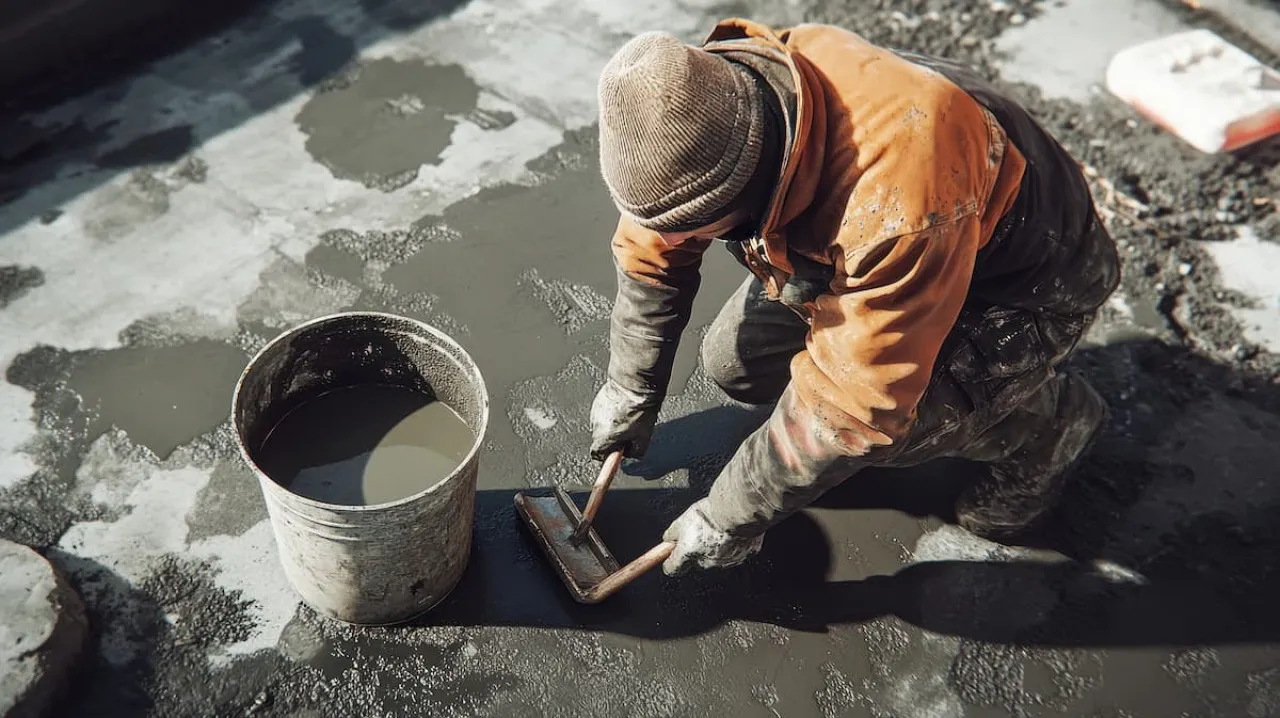
Liquid concrete bonding agents, whether natural or synthetic, are crucial for preventing cracks caused by poor joints between old and new concrete.
As a primary building material for structures such as buildings, roads, and bridges, concrete requires these bonding agents to enhance adhesion, reduce permeability, and ensure joints form a solid, sturdy, and durable bond.
Applied by brushing or spraying before pouring, the right bonding agent can determine your building’s structural durability. To help you choose the right one, read on for a complete overview of its functions, types, and application methods below!
What Is a Concrete Bonding Agent?
A concrete bonding agent is a chemical adhesive used to join old and new concrete and to bond concrete to other materials.
Made from synthetic resins, latex, Portland cement, or a combination of all three, this material creates much stronger mechanical and chemical bonds. Without this bonding agent, hardened old concrete loses its natural ability to bond.
As a result, the joint with the new concrete is at high risk of cracking, delamination, or reduced structural strength. Therefore, concrete bonding agents are essential to ensure that repairs or additions to concrete structures bond perfectly.
Types of Concrete Bonding Agents
On the market, there are several bonding agent options you can choose from depending on your project’s needs, including:
- Polyvinyl Acetate (PVA): Ideal for small-scale projects that don't require much material. In addition to blending well when mixed with cement, PVA also has high water resistance.
- Epoxy Bonding Agent: The right choice for structural concrete work. This epoxy offers proven compressive strength and exceptionally strong adhesion.
- Acrylic Latex Bonding Agent: This milky-white adhesive combines polymers and copolymers with a solids content of up to 45 percent. You can apply it flexibly using a brush or trowel.
Read also: Concrete in Construction: Learn the Functions and Types!
Functions of Concrete Bonding Agents
Using these bonding agents offers many benefits for maintaining your building's quality and durability. Generally, the main functions of these materials include:
- Bonding and strengthening the joints between old and new concrete, as well as other materials such as wood, steel, and stone, to ensure a solid bond that will not easily come apart.
- Sealing pores and micro-cracks in old concrete or damaged areas so the new layer can adhere optimally.
- Reducing the risk of cracking from shrinkage or structural movement with its high bond strength and flexibility.
- Providing extra protection against water, acids, salts, and other chemicals that could damage the concrete.
- Supporting repairs and coatings to reinforce structures, patch damage, and create protective or decorative layers.
Characteristics of Concrete Bonding Agents
Bonding agents offer several distinctive characteristics that make them highly reliable for construction projects. The characteristics of concrete bonding agents are as follows:
- Minimal risk of cracking: Helps maintain the integrity and long-term stability of concrete structures.
- Easy to apply: Can be applied directly on-site without a complicated process.
- High adhesion and performance: Capable of strongly bonding old and new concrete while optimizing compaction at joints.
- Improved tensile strength: Effective binding agents enhance tensile strength at joint areas.
- Low permeability: It creates a tight bond after the concrete hardens, leaving no gaps that could potentially cause water leaks.
When to Use Concrete Bonding Agent
Generally, this bonding agent is best applied immediately before pouring new concrete over the old layer. However, adjust the timing according to each product brand’s specific instructions.
Follow these guidelines because cement mortar has no natural bonding ability. If you pour new concrete directly without a bonding agent, problems like water leaks at the joints can compromise building integrity.
Read also: Get to Know Conventional Concrete, Its Advantages & Disadvantages
How to Apply Concrete Bonding Agent
For best results, follow these steps for applying a concrete bonding agent:
- Prepare the materials and identify their types: Have the product you will be using ready and understand its type and characteristics so the work process runs smoothly.
- Clean the work area: Ensure the concrete surface is clean. If the surface feels slippery or too smooth, sand it first to create a rougher texture.
- Stir and mix according to instructions: Follow the concentration ratios and mixing instructions on the product packaging to ensure the formula works properly.
How to Choose the Right Concrete Bonding Agent
To ensure the bonding agent performs optimally, tailor your product selection to the type and condition of the concrete to be bonded, as well as the purpose and installation location. Here are some important factors to consider when selecting a bonding agent:
- Compatibility with concrete: Ensure the bonding agent's physical and chemical properties match those of your concrete, including consistency, adhesion strength, curing time, and thermal expansion coefficient.
- Environmental resistance: Choose a material that resists changes in temperature, humidity, sun exposure, and chemicals in the work area.
- Practicality of application and cleanup: Choose a material that is easy to apply with simple tools, such as a roller, brush, or spray, and that can be easily cleaned off equipment with water or an appropriate solvent.
- Price and availability: Consider products that remain affordable and are readily available on the market.
In addition to choosing the right adhesive, building structural integrity also depends heavily on the quality of the underlying concrete. For this, you can rely on Beton Merah Putih from Semen Merah Putih.
Through its business lines, Semen Merah Putih supplies a range of innovative ready-mix concrete products, precast concrete, and aggregates designed to meet various project needs.
One of its flagship products, Ready-Mix Concrete, comes in a range of quality options tailored to your needs, from residential construction and high-rise buildings to industrial complexes and highway infrastructure.
Want to ensure your project runs smoothly with the best materials? Contact us today for a consultation and the most suitable construction solutions for your building.
Read also: High-Strength Concrete: Advantages, Manufacturing, & Uses