
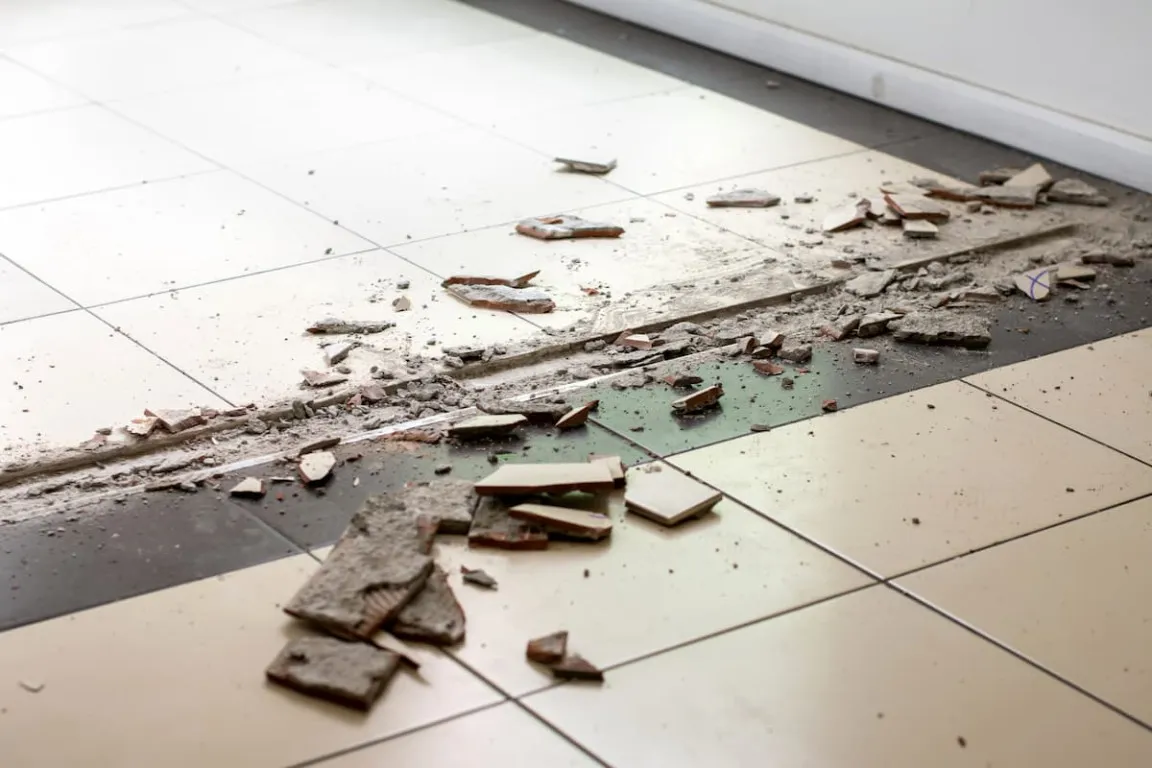
Improperly installed ceramic can suddenly lift and break with a loud bang, making the floor look damaged and potentially endangering the occupants of the house.
Floors prone to breaking often show signs, such as sounding hollow when tapped lightly. This sound indicates that some of the ceramic is not properly attached to the underlying building material.
To learn more about the causes of ceramic floor explosions and how to prevent them, read the full article here!
Causes of Ceramic Floor Explosions
Several factors can cause ceramic floors to explode. From changes in building structure to improper installation, all of these things can make ceramics prone to lifting or breaking. Here are some reasons why ceramic floors can explode:
1. Changes in Building Structure
Changes in the building structure can cause this problem. Structures such as columns, beams, and frames serve to support loads, so they need to be designed and installed correctly. That is why the solution to ceramic popping up usually begins with identifying the source of the problem, which is an unstable structure.
If the calculations are inaccurate or the workmanship is not precise, the concrete can crack, and parts of the structure can sag or sink. This condition can affect the building's strength and stability, while also increasing the risk of ceramic lifting or breaking.
2. Imperfect Installation
Homeowners should supervise the installation of the ceramic floor by workers. This is because improper installation can cause ceramics to lift or break suddenly.
One cause is during the screeding process, specifically when the cement is leveled as the base for the ceramics. If the cement layer is not dense enough and does not adhere properly, the ceramics will not bond perfectly. As a result, the ceramics may be pushed up or even crack and break later on.
3. Settling Foundation
Ceramic floors can lift or crack due to movement in the building structure, such as slight settling or shifting. Additionally, the ceramic and the cement layer underneath can expand at different rates when the temperature changes. This difference in expansion can put pressure on the ceramics, eventually causing them to lift or crack.
Therefore, ceramic should be installed when the building is stable and no longer experiencing significant movement. Installers also need to soak the tiles for the recommended time before installation. This soaking process is important to prevent the ceramics from absorbing water from the cement too quickly, thereby strengthening their adhesion and reducing the risk of lifting.
Read also: The Concept of Growing House: Building a House Step by Step
4. Temperature Changes
Another reason ceramic can lift or crack is temperature changes. This often happens to ceramics installed on a house's terrace because they are directly exposed to the sun's heat and rain. It can also happen inside buildings that use air conditioning because the temperature in each room or on each floor can differ.
The mixture of cement and sand under the ceramics is hard and inflexible. Therefore, when the temperature changes, the layer cannot adjust accordingly. As a result, pressure builds up on the ceramics until they eventually lift or crack.
5. Grout Spacing Is Too Tight
Floor ceramics can also lift or crack because the grout joint spacing is too tight. Grout is the material in the small gap between ceramics. Indeed, very close grout spacing looks neater. However, this condition can actually cause problems.
When the temperature changes, the ceramics can expand slightly. If the gaps are too tight, the ceramics have no room to move. As a result, the ceramics press against each other until they eventually lift or come loose. Therefore, when installing ceramics, it is necessary to leave sufficient grout gaps, usually around 1–3 mm, to allow room for the ceramics to expand.
6. Shrinkage of Cement and Sand Mortar
Shrinkage of cement-sand mortar can be one of the causes of ceramic floor tiles lifting or breaking.
Mortar is a mixture of cement, sand, and water used as a ceramic base. This mixture must be made with the correct proportions. If there is too much water or the proportions are incorrect, the mortar can shrink as it dries.
When the mortar shrinks, the layer under the ceramics also shrinks. This can put pressure on the ceramics, causing them to lift, crack, or even break.
Read also: Concrete Hardener Ratio: How to Calculate and Apply It
7. Heavy Loads Exceeding Capacity
Placing very heavy furniture, such as metal cabinets or pianos, on ceramic floors for extended periods can put significant strain on the floor.
If the underlying installation is not strong or neat, heavy pressure can cause the ceramic to crack or lift. Continuous pressure on one spot can increase the risk of damage.
8. Improper Ceramic Soaking Process
Old ceramics usually need to be soaked before installation to prevent them from absorbing water from the cement too quickly. If not soaked, the cement can dry quickly, reducing its adhesive strength. However, modern ceramics, such as granite tiles, do not need to be soaked because their pores are very small and they do not absorb much water.
Those are some of the causes of ceramic floor explosions, ranging from changes in building structure to improper soaking processes. By understanding these factors, you can be more careful during installation. Ensure that the structural calculations are thorough, the mortar mixture is made with the correct proportions, the grout spacing is not too tight, and the installation technique is carried out according to procedure.
To keep ceramics strong and prevent them from lifting, it is also important to use high-quality building materials. One option to consider is the Semen Merah Putih Watershield from Semen Merah Putih. This premium multi-purpose cement is suitable for masonry, plastering, and even screeding as a base for ceramics.
The water-repellent technology in it helps protect against water seepage, making the mortar more resistant to moisture and less prone to damage. With the right materials and proper installation, ceramic floors can be more durable, easier to maintain, and more comfortable to use in the long term.
Contact us for more information and to discuss which building material you need for your project!
Read also: Structural Walls: Definition, Functions, and Types