
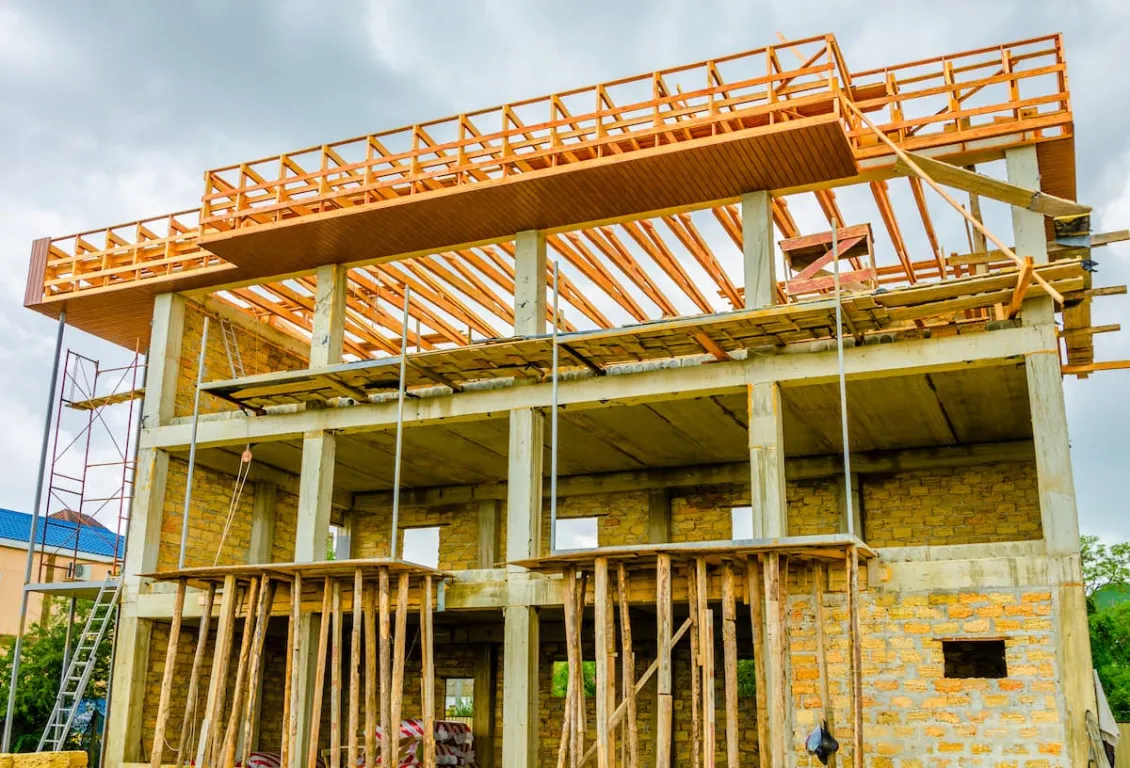
Support and span beams are key concepts in building structures that homeowners, foremen, laborers, contractors, and building consultants must understand. These two components determine how loads from the floor or roof are transferred to the columns, ensuring the building stands safely and stably.
In reinforced concrete construction, beams do not function uniformly along their entire length. Some sections resist shear forces near the columns, while others primarily resist bending moments in the middle of the span.
This is where the concepts of support beams and slabs become crucial to ensuring the building's structural integrity. Understanding the difference between the two also helps you read structural working drawings more easily.
Furthermore, this knowledge is essential to ensure the home construction process adheres to proper technical standards, thereby minimizing the risk of cracks, deflection, or structural damage.
What Are Support and Span Beams?
In reinforced concrete structures, support and span beams refer to two main areas within a single beam that experience different types of forces. A support beam is the portion of the beam located at the end of the span and directly connected to a supporting column or wall.
In this area, loads from the floor or roof are first transferred from the beam to other structural elements, such as columns. Because it is located at a point of force transfer, it typically experiences significant shear forces.
Conversely, the span beam is the section of the beam located in the middle of the span, far from supporting columns or walls. In this area, the dominant force is the bending moment caused by the load acting on the beam. Therefore, the reinforcement used in the span area is typically designed to resist positive bending moments.
In construction practice, the concepts of support and span beams are not only used in structural calculations but are also clearly visible in detailed reinforcement drawings. The difference in reinforcement patterns between these two areas is based on an analysis of the forces acting on the beam.
Read also: Ring Beam: Definition, Types, and How to Calculate It
Differences in the Functions of Support and Span Beams
Although they are part of the same structural element, support and span beams serve different functions in supporting forces within a building. Here are the key differences in their functions that you should know.
1. Location on the Beam
Support beams are located at the ends of the span, the sections that connect to columns or structural walls. This is where the beam load is transferred to the building’s vertical elements. Meanwhile, the span beam is located at the midpoint of the span. This section is typically the longest part of a beam and is the primary point of deflection.
2. Types of Forces at Work
The most significant difference between support and span beams lies in the dominant types of forces they carry. In simply supported beams, shear forces and negative bending moments are the primary factors the structure must resist. These high shear forces can cause shear cracks if the reinforcement is not properly designed.
In contrast, in span beams, the dominant force is the positive bending moment. This force causes the beam to deflect downward due to the load from the floor or roof above it.
3. Differences in Reinforcement
Due to these differences in forces, the reinforcement details in the support and span areas of the beam also differ. In the support area, stirrups or shear reinforcement are typically placed closer together. This is intended to enhance the beam’s ability to resist larger shear forces.
Meanwhile, in the span area, the bottom reinforcement is usually more dominant because it must resist positive bending moments. The spacing of the stirrups in this section is typically wider compared to the support section.
For example, in structural working drawings, the stirrup spacing at supports can be around 100 mm, while in the span, it can reach 200 mm. This difference is the result of technical calculations, not merely a practical decision made on-site.
The Importance of Support and Span Beams in Structural Design
Many people assume that beams serve only as connectors between columns. However, in structural design, understanding support and span beams is crucial for maintaining a building’s strength and safety.
In the support area, the risk of damage due to shear forces is very high. If the shear reinforcement is not sufficiently dense, shear cracks can occur and potentially reduce the beam’s strength significantly.
Meanwhile, in the span area, a common issue is excessive deflection. If the flexural reinforcement is not properly designed, the beam may deflect excessively, causing cracks in the floor or walls above it.
By understanding the roles of support and span beams, you, as a homeowner or project supervisor, can be more thorough in reviewing construction drawings and monitoring the on-site reinforcement installation process. This also helps ensure that the building is not only visually sturdy but also structurally safe.
Read also: Understand the Cantilever Beam Formula & Its Calculation Steps
The Role of Construction Standards in Beam Design
In civil engineering practice in Indonesia, the design of support and span beams follows nationally established reinforced concrete design standards. Therefore, designs must comply with these established standards.
These standards govern key aspects, including beam dimensions, minimum reinforcement quantities, stirrup spacing, and reinforcement placement details. The goal is to ensure that every structural element can withstand the forces acting on it throughout the building’s service life.
In the support area, standard regulations typically require closer stirrup spacing due to higher shear forces. Meanwhile, in the field area, the primary focus is on ensuring the beam can withstand the positive bending moments occurring at the mid-span.
By adhering to these rules, the design of support and span beams can provide a more balanced distribution of forces along the beam's length. This is particularly important in multi-story buildings or two-story houses that carry larger, more complex structural loads.
Conclusion
Understanding support and span beams is a crucial step for anyone involved in home construction, from homeowners to contractors and building consultants. These two types of beams serve different functions in resisting forces and thus require different reinforcement details.
Support beams resist shear forces and negative moments near columns, requiring denser stirrups and stronger top reinforcement. Conversely, span beams are located in the middle of the span and are primarily designed to resist positive bending moments, with bottom reinforcement being more dominant.
By understanding the concepts of support and span beams, you can ensure that the building structure is designed correctly, in accordance with standards, and capable of withstanding the test of time.
Use High-Quality Materials for Optimal Structural Performance
In addition to proper design, the quality of materials is also a key factor in determining a building’s structural strength. For a wide range of general construction needs, Semen Merah Putih Ultramix-G can be the right solution for your project.
This Portland cement is specifically designed for construction applications that do not require special specifications, such as sulfate resistance or low heat of hydration. This product is suitable for both ready-mix concrete and precast concrete, offering optimal strength development and ease of workability.
Semen Merah Putih Ultramix-G offers several advantages, including high compressive strength, good workability that facilitates pouring, and an optimal setting time that supports on-site work efficiency.
Contact us now to learn more about Semen Merah Putih Ultramix-G and discover the best construction material solution for your building project.
Read also: Porous Concrete: Characteristics, Causes, & How to Fix It