
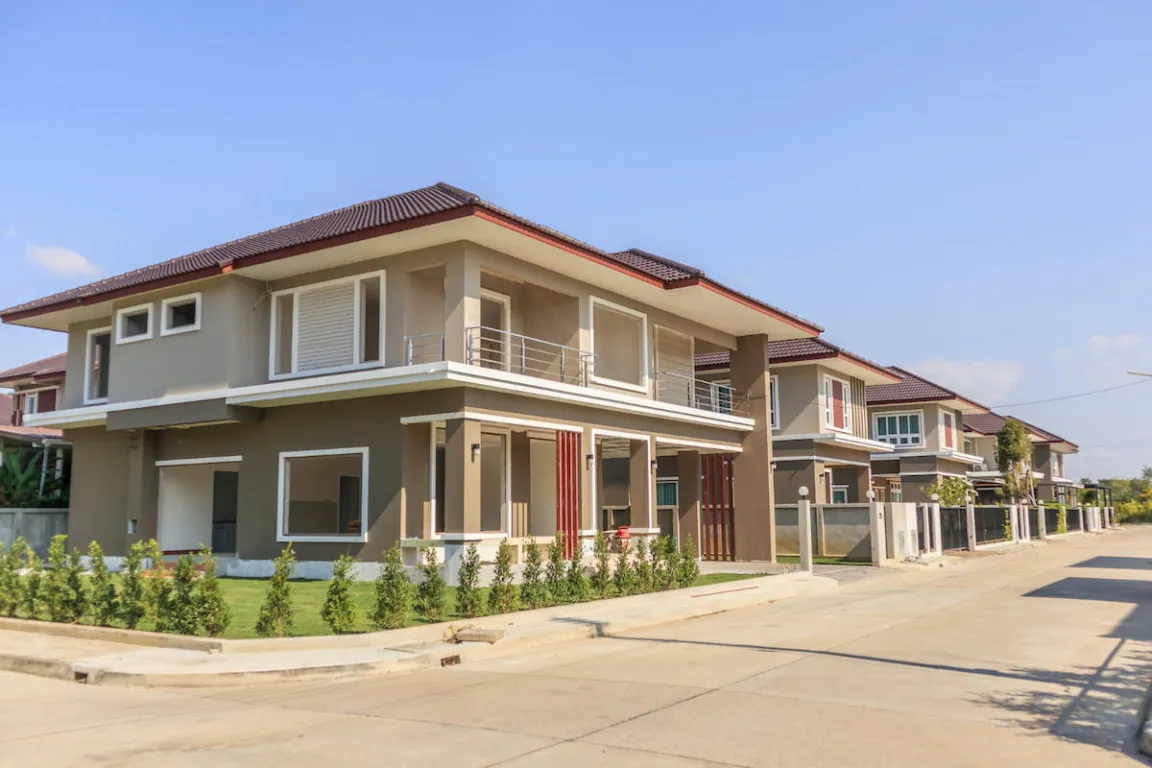
The size of a 2-story house's footplate foundation is one of the important things to consider when planning construction. A footplate foundation is a common foundation type because it is simple, offers many advantages, and is suitable for 1- to 2-story buildings.
If you are calculating the size of a 2-story house foundation, understanding what a footplate foundation is, how to construct it, and when it should be used will significantly advance your construction project. For that, read about it below.
Size of a 2-Story House Footplate Foundation
Footplate foundations are generally used on hard, stable ground for 1- to 2-story houses. If the soil conditions at the building site are dense and compacted, this foundation is well-suited. However, if the soil is soft, other foundation types, such as pile foundations or bore piles, are more appropriate.
The size of a 2-story house's footplate foundation should be larger, typically 70x70 cm to 100x100 cm, depending on the column span and building load. The depth of the foundation is usually about 150 cm below the original ground level, assuming normal soil conditions.
The reinforcing steel is 12 mm in diameter, and the concrete quality is in the range of K175–K225, with a minimum mixture ratio of 1:2:3 (cement : sand: gravel). These specifications are generally used for simple 2-story houses with a structural span of around 3 meters.
The Function of Footplate Foundations in 2-Storey Houses
In 2-storey houses, footplate foundations provide the primary support for the structure above. These 2-story house foundations bear vertical loads, such as dead loads, live loads, and earthquake loads, and also transfer them to the ground.
At the planning stage, the footplate foundation must meet safety requirements in accordance with Indonesian standards, including the determination of appropriate length, width, and thickness.
Factors Affecting Footplate Foundations in 2-Story Houses
In practice, footplate foundations in 2-story houses can vary in size, depth, and the rebar used. These differences are influenced by several important factors, as follows.
1. Building Structure Distance
The wider the span of the pillars or columns in a building, the larger the footplate foundation must be. For residential houses, a standard column span of approximately 3 meters is sufficient and aligns with the size of most rooms.
However, if the structure span exceeds 4 meters, it is advisable to perform a structural analysis or consult a construction expert to ensure the foundation remains strong and safe.
Read also: 17 Types of Foundations in Constructions and How to Choose Them
2. Soil Conditions
Soil conditions are an essential factor in planning a footplate foundation. Each type of soil has a different bearing capacity, ranging from hard soil, yard soil, rice fields, and swamp soil. These differences significantly affect the size and depth of the foundation required.
If the house is built on hard ground, standard footplate foundations are sufficient. However, for swampy or fill soil, the foundations need to be larger and deeper to ensure the building remains stable.
3. Building Height
The building's height directly affects the footplate foundations because the higher the walls, the greater the load the foundations must carry. For example, a 4-meter-high wall is certainly heavier than a 3-meter-high wall, so this factor is quite significant in determining the foundation's strength requirements.
4. Building Load
The building load significantly affects the size of the footplate foundation, where the heavier the materials used, the larger the foundation required. Simply put, the weight of a building is generally influenced by two main factors, which are the type of material and the building’s height.
For example, red bricks are heavier than concrete bricks, concrete slabs are heavier than panel slabs, and concrete tiles are heavier than metal tiles. Similarly, wooden roof frames are heavier than lightweight steel frames and heavier than aluminum or UPVC frames.
Based on this comparison, it is best to choose lighter building materials if you want a stronger foundation with minimal risk.
How to Build a Footplate Foundation
Like other building elements, the construction of a footing foundation must follow these proper steps to ensure a strong and safe result. Here are the steps that are usually taken:
- Excavation: Excavate the soil according to the planned base width and depth, then double-check that the excavation results match the plan.
- Reinforcement assembly: Assemble the footplate foundation reinforcement bars to the specified diameter and shape, in accordance with the working drawings.
- Installation of backfill sand: Spread 5–10 cm of sand on the excavation base, then level and compact it.
- Work floor construction: Construct a 5 cm thick work floor on top of the backfill sand using a mixture of 1 cement: 4 sand: 5 split. For the record, the composition of this mixture may vary.
- Reinforcement placement: Place the reinforcement frame on the work floor at the planned position.
- Formwork installation: Install formwork to shape the foundation before casting.
- Concrete casting: Cast concrete of good grade per the plan to ensure the foundation is sturdy and durable.
Read also: Staddle Stone Foundation: Definition and How to Install it
Important Tips to Consider Regarding Footplate Foundations
After understanding the steps for constructing a footing foundation, it is also important to consider several key points to ensure the result is stronger, more durable, and safer.
In addition to monitoring the construction process, factors that affect the building's long-term durability should also be considered when constructing a footplate foundation. Here are some tips:
- Ensure that the installation method is correct; do not simply follow the contractor's instructions.
- Double-check the material specifications, concrete quality, and steel diameter to ensure they match the plan.
- The depth of the foundation and the quality of the concrete must be considered, as they significantly affect the footplate’s bearing capacity.
- If you want to reduce the size of the footplate foundation for a 2-story house, use lightweight building materials, such as lightweight bricks, lightweight steel, or deck panels, to reduce the load on the foundation. Note that this factor should not be the sole reason for lowering the foundation size without careful structural calculations.
- In soil conditions, such as swampy or sloping soils, or when column spacing exceeds 4 meters, it is advisable to consult a structural engineer for a safer design.
Choosing the proper foundation is the first step towards maintaining the house’s long-term strength and durability. Footplate foundations, with their advantages, are an efficient choice for low to medium-rise buildings such as 2-story houses.
However, the quality of a foundation depends not only on its design but also on the materials used. For the best results, choose high-quality materials, such as Semen Merah Putih Watershield.
With water-repellent technology, Semen Merah Putih Watershield provides triple protection for buildings by preventing seepage through the exterior, interior, and ground. As a result, houses become stronger, more durable, and less maintenance-intensive.
As a super-premium, multi-purpose cement, this product is suitable for a wide range of construction applications, from foundations and concrete slabs to castings, brickwork, plastering, and rendering.
So, what are you waiting for? Contact us immediately for more information and get the best construction solutions for your dream house project.
Read also: Rollag Foundation: Definition, Function, Types, & Advantages