
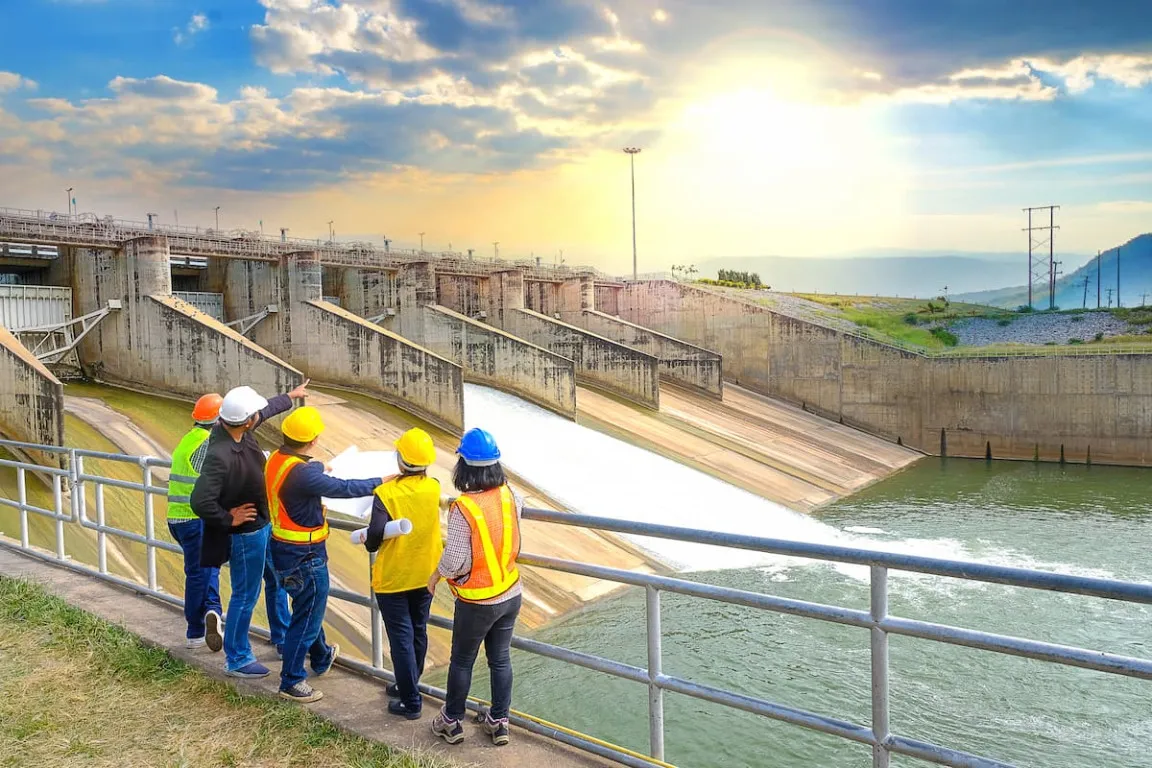
Dam construction is the process of building infrastructure that retains and controls water flow by forming reservoirs. Dams play a crucial role in water supply, irrigation, flood control, and energy security, especially in Indonesia, which has diverse geographical conditions.
Given that the construction process requires careful planning and complex methods, it is essential to understand the stages and components involved in dam construction. Read this article to understand more about it.
Understanding Dam Construction Technology
In recent decades, dam construction technology in Indonesia has undergone rapid development. Planning now largely uses geospatial technology, while the construction process has become more efficient through the use of compacted concrete.
On the other hand, reservoir monitoring has become more sophisticated through automation and information technology, enabling real-time monitoring. Material innovations, such as polymer-reinforced concrete, are also being used to support the long-term safety and durability of structures.
These developments demonstrate that technology is an essential element in the construction of more reliable and sustainable dams.
Functions of Dams
Based on Minister of Public Works Regulation Number 27 of 2015, dams create reservoirs that can be used for various important purposes. The following are some of the main functions of dams:
- Raw water supply: Water stored in reservoirs can be treated and used for household and industrial needs.
- Irrigation water supply: Dams are a source of water for agricultural land, especially during long dry seasons.
- Flood control: By holding back high water discharge during the rainy season, dams help reduce the risk of flooding in downstream areas.
- Hydroelectric power plants (PLTA): Water from dams is used to drive turbines and generate environmentally friendly electricity.
Read also: Concrete in Construction: Learn the Functions and Types!
Dam Construction Process
Dam construction cannot be carried out carelessly. Each stage is carried out sequentially, with strict technical standards, to ensure the dam structure is safe, strong, and functions optimally. The following is an overview of the construction process:
1. Initial Preparation
The initial stage begins with the construction of a project coordination center. Next, measurements and coordinate points are taken to ensure that the construction location is in accordance with the plan.
2. Clearing and Access Road Construction
The construction area is cleared of vegetation and other obstacles. After that, access roads are constructed to facilitate the transportation of heavy equipment and workers to the project site.
3. River Excavation and Diversion
To keep the work area dry, a temporary diversion channel is constructed to temporarily divert the river flow during construction.
4. Cofferdam Construction and Dewatering
A cofferdam is built as a temporary dam to hold back river water and direct it to the diversion channel. After that, the water in the work area is pumped out through a dewatering process.
5. Structural Strengthening
The walls and slopes resulting from the excavation are strengthened with shotcrete to prevent landslides. Grouting is also conducted to seal cracks in the soil and increase the foundation's structural strength.
6. Dam Body Construction
Once the area is stable, the dam body is constructed by gradually excavating and filling material to form the main structure of the dam.
7. Supporting Infrastructure Construction
An access road, complete with aggregate and asphalt layers, is built on top of the dam body. Additionally, intake and outlet structures are built for water intake and distribution.
8. Spillway Construction
A spillway is designed as a channel for releasing excess water to prevent water pressure from damaging the dam structure.
9. Hydromechanical Construction
This stage includes installing floodgates, piping systems, electrical installations, and the power house, especially for dams used as power plants.
10. Plugging and Impounding
The construction process is completed with plugging, which involves closing the diversion channel using reinforced concrete. After that, impounding is carried out by gradually filling the dam with water until it reaches its planned capacity.
Read also: Cyclopen Concrete: Definition, Characteristics, & Its Uses
Dam Construction Components
Each dam is composed of various interconnected components, each with its own function. For the dam to operate safely and optimally, all these components must be designed and constructed in an integrated manner. The following are the components of a water dam that you need to know:
1. Dam Body
The dam body is the main structure that holds back water. In addition to holding back water, this part works along with other components, such as embankments and floodgates, to regulate the flow to specific areas. The retained water pressure can also be utilized, including for power generation.
2. Foundation
The foundation is the base that supports the entire dam structure. This part plays a crucial role in maintaining the dam’s long-term stability and strength to withstand the water load.
3. Water Gates
Water gates regulate the water flow in and out of the dam. They consist of several parts, including a gate leaf to withstand water pressure, a guide frame to keep the gate moving in the right direction, anchors to secure the frame to the concrete, and hoists to facilitate the opening and closing of the water gates.
4. Spillway
The spillway drains excess water when discharge increases to prevent damage to the dam. This structure consists of a flow guide channel, a water discharge channel, and an energy dissipation structure that reduces the force of the water before it is discharged downstream.
5. Canal
The canal is used as a spillway, especially during high rainfall, to keep the water flow under control.
6. Reservoir
A reservoir is a water storage area located behind a dam. This section serves to receive and store water from the dam for various needs.
7. Stilling Basin
A stilling basin acts as a water-energy dissipator, with a function similar to that of a dissipating structure in a spillway, ensuring that the water flow does not damage the surrounding area.
8. Valves
Valves are used to regulate water flow in pipes, pressure tunnels, or rapid pipes. Compared to ordinary floodgates, valves can withstand higher water pressure and operate using a rotating or sliding mechanism.
9. Drainage Gallery
The drainage gallery serves as a supporting component of the power generation system in a dam and assists in managing water flow within the dam structure.
That concludes the information on dam construction, from the construction process and its important functions to its constituent components. It can be seen that a dam is not merely a structure that holds back water, but a complex piece of infrastructure that requires careful planning, appropriate implementation methods, and high-quality materials.
Therefore, material selection is a crucial factor in determining a dam's strength, safety, and longevity. The right materials will help the structure remain stable, withstand water pressure consistently, and be more resistant to various environmental conditions.
To support these needs, Beton Merah Putih, part of Semen Merah Putih, provides construction material solutions, including Ready-Mix Concrete, Precast Concrete, and supporting aggregates, all produced to high-quality standards. These products are designed for large-scale dam projects that require durability, density, and long-term performance.
If you need high-quality materials or technical support for dam construction, contact us immediately. Let’s build stronger, safer, and more sustainable dams with Beton Merah Putih!
Read also: Construction Engineering: Its Function, Types, & Examples!