
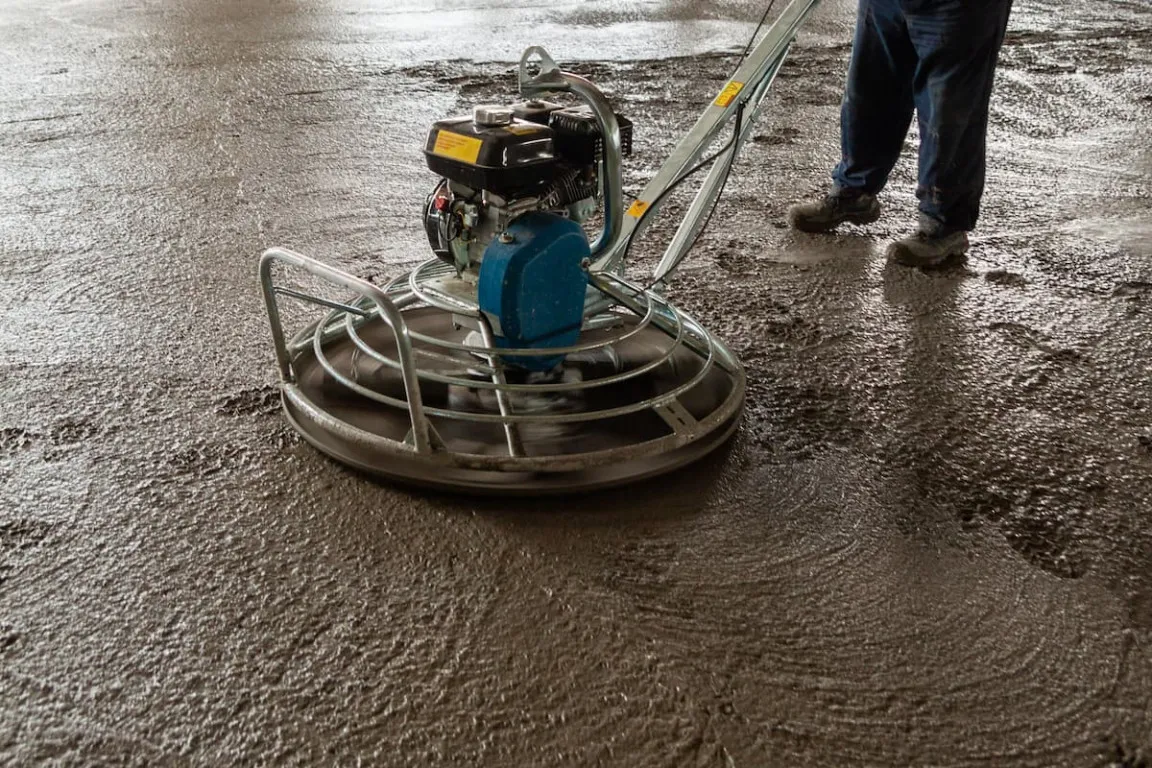
In the construction process, especially in concrete floor work, the finishing stage plays an important role in determining the final quality.
A flat, smooth, and strong concrete surface not only enhances appearance but also affects durability for long-term use.
To achieve these results, the right tools are required, one of which is a concrete trowel. In this article, you will learn what a concrete trowel is, its main functions, and the various types of concrete trowels that can be adjusted to your project needs.
What Is a Concrete Trowel?
A concrete trowel is a tool used to level, smooth, and compact the surface of concrete after the pouring process.
This tool is usually used in the finishing stage to ensure the concrete surface becomes neater and has an optimal appearance.
The use of trowels is very common in concrete floor projects such as warehouses, factories, parking areas, and residences.
Concrete Trowel Function
After understanding the definition of a concrete trowel, you might be wondering what important roles this tool has in the construction process. There are several functions of a concrete trowel that you need to know:
- Level the concrete surface so that it is not wavy.
- Smoothing the surface for a neater finishing result.
- Compacting the top layer of concrete to make it stronger.
- Reducing pores on the concrete surface.
- Increasing the concrete's resistance to abrasion or friction.
It is important to know that these functions depend on the type of concrete trowel used. In the next section, you can learn about the various types of concrete trowels so they can be adjusted according to the needs of your project.
Types of Concrete Trowels
Each type of concrete trowel has different characteristics and ways of use, depending on the scale of the work and the desired outcome.
By understanding the differences of each type, you can choose the most suitable tool so that the finishing process runs more effectively and the results are optimal. Here is an explanation of each type:
1. Manual Trowel
A manual trowel is a type of trowel operated manually. This tool usually has the shape of a flat board with a top handle and consists of several types, such as steel trowels, notched trowels, and pointed trowels.
The advantage of a manual trowel is that it is easier to use without requiring a machine. However, the working process tends to be longer and requires more physical effort.
Additionally, the finishing results with a manual trowel are highly dependent on the user's skill. Without the proper technique, the concrete surface may be uneven or not as smooth as the results of a mechanical trowel.
Therefore, this type of trowel is suitable for small or narrow areas, detailed work, light finishing, or small-scale household projects.
2. Mechanical Trowel
The second type is the mechanical trowel, often also called a power trowel. As the name suggests, this tool uses a machine to assist in the leveling and smoothing process of concrete.
Mechanical trowels are usually used for large areas, such as warehouses or factories, large-scale projects, or work that requires high time efficiency. There are two types of mechanical trowels, namely walk-behind power trowels and ride-on power trowels.
The advantages of a mechanical trowel include being able to speed up the work process and produce a more even concrete road layer.
However, a mechanical trowel also has some disadvantages. This tool requires higher costs, both in terms of equipment and operations.
Additionally, the use of a mechanical trowel also requires more careful planning, such as determining the time of use and the condition of the concrete surface. If used at the wrong time, the finishing results can actually be less than optimal.
Read also: 15 Construction Tools and Their Functions, Take Note!
Tips for Using a Concrete Trowel
To achieve a more optimal finishing result, the use of a concrete trowel also needs to be carried out with the correct technique. One important thing to pay attention to is the timing of use.
Ideally, the trowel is used when the concrete begins to harden. Specifically, when the surface is neither too wet nor too dry.
Additionally, carry out the leveling process gradually so that the final result is neater and more even. Using a clean concrete trowel is also equally important because attached dirt can affect the quality of the concrete surface.
You also need to choose the type of concrete trowel that suits the project's needs. Is the project for a small area? Do you need a manual or mechanical trowel? With the right technique and tool selection, the final concrete floor will be smoother, stronger, and more durable.
Besides using a concrete trowel, the materials used for concrete floors also affect the final result. Therefore, choosing quality cement will help produce a smoother, stronger, and more durable surface.
One option you can consider is Semen Merah Putih FLEXIPLUS, which is designed to provide high adhesion, ease of application, and a more optimal final result for various construction needs.
Moreover, for efficiency and consistency in quality, you can also use Ready Mix Concrete. This product is manufactured with a controlled composition, ensuring better quality and speeding up the work process, especially for large-scale projects.
For more information about products and construction solutions that meet your needs, do not hesitate to contact us.
Read also: Get to Know Concrete Mix Design for Sturdy Construction