
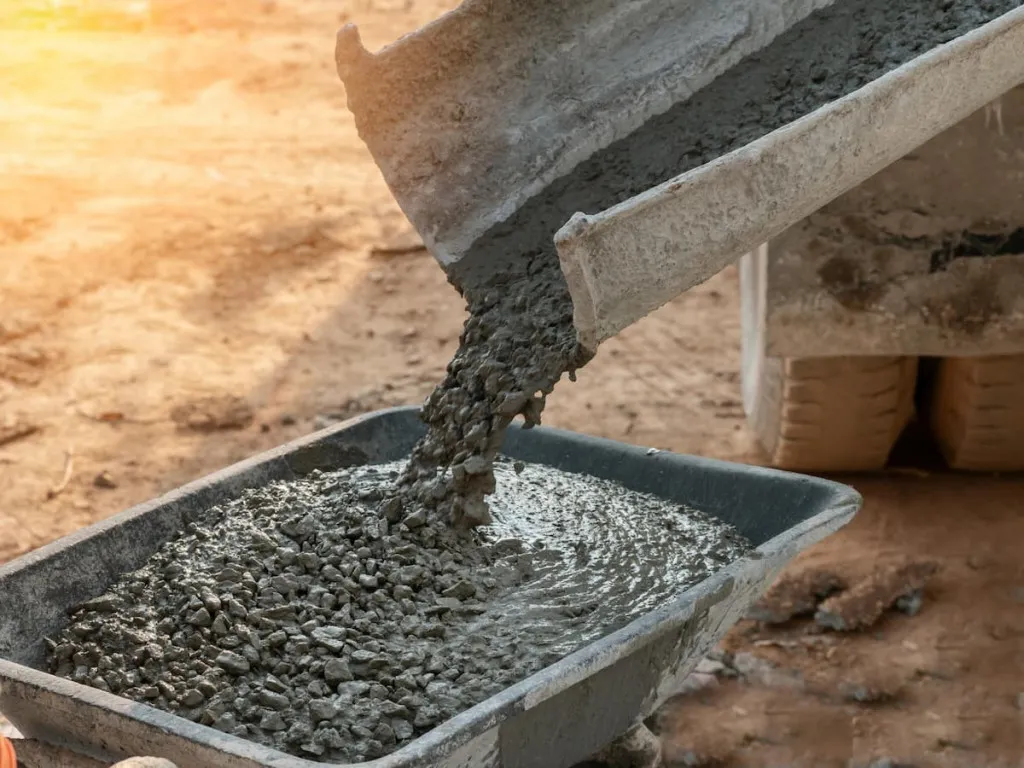
A concrete retarder in concrete casting is an admixture that slows down the hardening or setting process of concrete. This material works by regulating the rate of chemical reaction between cement and water, allowing the time needed for concrete to begin hardening to be extended as necessary.
For some people, this concept may seem counterintuitive. After all, the faster the concrete hardens, the faster a building can be completed, right? To get a better understanding of concrete retarder, read the following details!
What Is a Concrete Retarder?
A concrete retarder is an additive in concrete mixes that is used to slow down the hardening or setting process of cement paste. Under certain conditions, such as hot weather, cement mortar will harden more quickly. This can pose difficulties for construction workers because they must use the mortar as soon as possible before it hardens.
The presence of a retarder helps extend the working time of the concrete, so workers have enough time to perform casting and leveling more optimally.
This time delay in hardening is crucial because the short time difference can affect the concrete grade, potentially causing wall cracks and resulting in imperfect joints.
Functions of Concrete Retarder
The application of concrete retarders in construction not only slows down the hardening process but also offers various benefits that give a good-quality result. Some of the functions of concrete retarder include:
1. Reducing Slump Loss
One function of concrete retarders is to reduce slump loss. With its ability to slow down the hardening process, retarders can maintain the workability of concrete longer, thus making it easier to cast and form concrete as needed.
2. Reducing Hydration Heat
Although retarders do not relieve the heat generated from the hydration process, they can delay the peak temperature rise during concrete hardening. This function is very useful for controlling heat, especially during mass casting in hot climates.
3. Reducing Cracks
Adding retarders to concrete mixes can help reduce the risk of cracks on the concrete surface. With a more controlled hardening time, the potential for plastic cracks that often appear in the early stages after casting can be minimized.
4. Improving Building Quality
Retarders also play a role in improving concrete quality and smoothing the finishing process. Because the hardening time can be precisely controlled, construction workers can more easily enhance the look of the concrete to make it flat and smooth.
Read also: The Right Concrete Mix Ratio According to SNI Standards
Types of Concrete Retarders
Much like the various types of concrete that are used according to construction needs, concrete retarders also come in a variety of types, each with its own characteristics and functions.
In general, retarders for concrete mixtures are divided into two main groups, namely carbon compound-based organic retarders and mineral salt-based inorganic retarders. Here is an explanation of each:
1. Organic Retarders
Organic retarders generally use carbon-based compounds to inhibit water adsorption on cement particles, such as calcium silicate hydrate (C-S-H). The mechanism of this type of retarder is to form a temporary barrier layer so that water penetration into the cement particles is inhibited.
Some commonly used types of organic retarders include sugars (such as glucose and sucrose), lignosulfonates, and hydroxy carboxylic acids ( such as citric acid and tartaric acid).
This type of retarder is often applied to precast concrete, exposed aggregate, and decorative concrete. The advantages of organic retarders are consistent and predictable setting times, as well as the ability to improve the workability of concrete mixes during the casting process.
2. Inorganic Retarders
Inorganic retarders are generally made from mineral salts that can interfere with the cement hydration process through reactions with calcium ions (Ca). These reactions form complex compounds that are difficult to dissolve, thereby slowing down the hydration rate and inhibiting the concrete setting process.
Some examples of compounds used in inorganic retarders are borates, phosphates, zinc salts, and lead. This type of retarder is usually applied in special constructions, such as deep well grouting, radiation shielding buildings, or nuclear reactors.
Read also: Functions of Concrete Curing, Factors, and Methods
Benefits of Using Concrete Retarders
After understanding the definition, function, and types of concrete retarders, it is also important to know the benefits of their use in construction.
Retarders are not just additives to concrete mixtures, but also play a strategic role in ensuring the quality, durability, and ease of working with concrete, especially in large-scale projects or those with specific working conditions.
The following are the main benefits of using concrete retarders:
- Slows down the setting time.
- Prevents the formation of cold joints (concrete hardens before the next mix is poured).
- Assists in large-scale casting work.
- Reduces the risk of concrete cracking.
- Enables long-distance transportation.
- Improves the final quality of concrete structures.
How Does Concrete Retarder Work?
Retarders in concrete mixtures work by slowing down the setting time between cement and water. This process is known as the hydration reaction. When cement is mixed with aggregate and water, an initial hydration phase occurs, followed by a dormant phase. In this dormant phase, the cement mixture is still wet, plastic, and easy to apply.
Typically, the dormant period lasts about 2–4 hours, marked by the formation of Calcium Hydroxide. After that, the cement paste will transition from a plastic phase to a rigid phase and eventually harden completely.
In this case, the main function of a retarder is to maintain the plastic phase longer so that workers have enough time to perform casting or finishing work. Retarders generally contain one or a combination of ingredients such as organic acids, sugars, lignosulfonates, or phosphoric acids.
The compounds in retarders work by forming a protective layer around the cement particles so that water does not immediately react with the active compounds inside. Another mechanism is to delay the formation of crystals due to the hydration reaction. This inhibition is temporary, usually only 1–3 hours, depending on the type and concentration of the retarder material used.
That is all, a complete explanation of concrete retarders, from their function, types, benefits, to how they work. The application of retarders has been proven to help control the hardening time of concrete so that the casting process can run more optimally. The amount and type can also be adjusted to the needs and characteristics of the construction being worked on.
To produce strong and durable building structures and castings, high-quality supporting materials are essential. In this regard, Ready Mix Concrete and Precast Concrete from Semen Merah Putih offer the perfect solution, with guaranteed quality and compliance with national construction standards.
With Beton Semen Merah Putih's solutions, your project will be more efficient in terms of time, labor, and cost, while minimizing logistical and scheduling challenges.
Want to discover more about our products or consult about your construction needs? Contact us now and bring your dream project to life with Semen Merah Putih.
Read also: Concrete Compressive Strength: Definition and Underlying Factors