
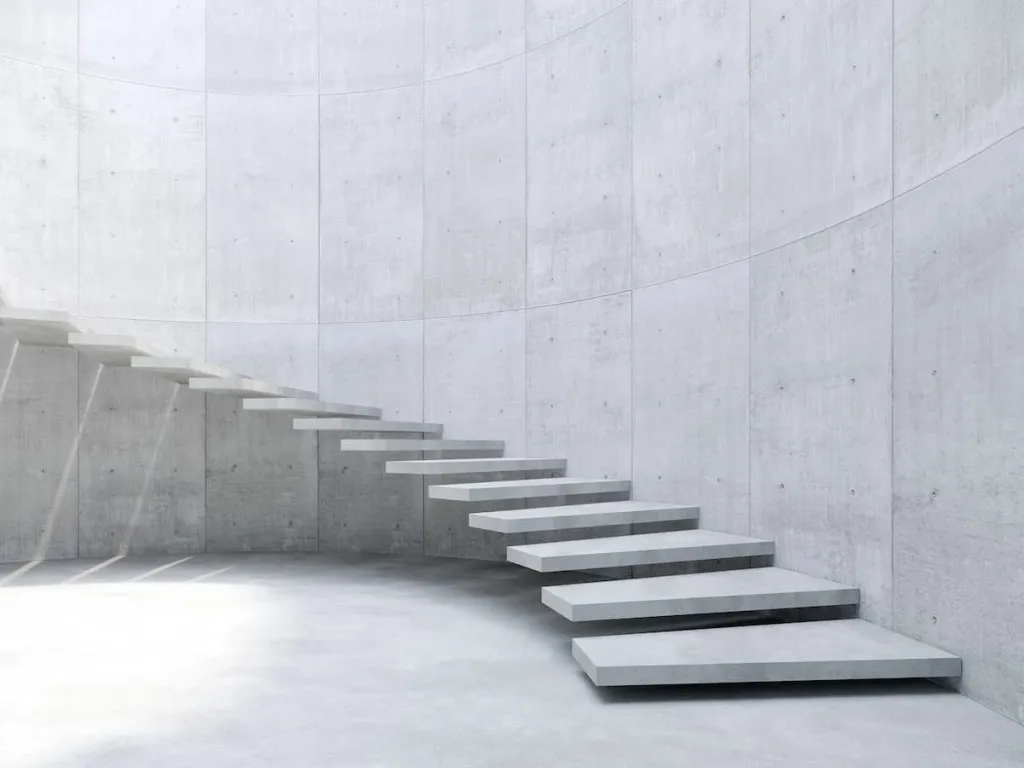
Concrete floating stairs have now become a favorite choice in modern home design because of their unique, minimalist, and elegant appearance. Unlike conventional stairs that have supporting posts, this type of stair features steps that seem to hang without a supporting structure.
Although they appear light and simple, the construction of concrete floating stairs actually requires careful technical planning. This article will thoroughly discuss the design, materials, construction process, advantages, disadvantages, and safety tips that you need to consider.
Understanding the Design and Construction of Concrete Floating Stairs
Visually, concrete floating stairs do not have posts or supporting structures beneath the treads. However, in reality, each step is securely connected to the main structure within the wall using a cantilever system. This system operates on the principle of load balance, with most of the structure embedded and locked into reinforced concrete beams within the wall.
For those of you who work as foremen, workers, contractors, or building consultants, it is important to understand that the main strength of concrete floating stairs lies in the frame implantation system into the wall structure. The stair frame generally uses:
- Thick steel plates, at least 5–6 mm.
- Structural steel.
- Reinforced concrete.
- A combination of steel and slanted concrete beams.
Steel plates are usually welded and connected to reinforced concrete beams inside the wall using embedded bolts or anchor bolts. On the sides, the frame will be covered with wire mesh, cement plaster, and paint finish so that the structure is not visible. The result is a staircase that truly appears to float.
The system, which relies on the strength of the wall, means the floating concrete staircase almost always attaches to one side of a structural wall. Therefore, structural analysis is very important before construction begins.
Advantages of Concrete Floating Stairs
Concrete floating stairs are increasingly common today, both in homes and commercial buildings. But, why are these stairs becoming more popular though? Here are some reasons that make this type of staircase sought after by homeowners and developers:
1. Modern and Elegant Appearance
This staircase can become the focal point of the interior. The sturdy concrete character combined with minimalist design creates a luxurious impression, yet remains simple. Suitable for modern, industrial, and contemporary minimalist-style homes.
2. Giving the Illusion of a Larger Space
Without a closed bottom structure, the area under the stairs feels more open. The room appears brighter, more spacious, and not cramped. Suitable for homeowners or buildings that do not want their space to look bulky due to the presence of stairs.
3. More Flexible Use of Space
For developers or contractors, floating stairs can be an added value in selling the concept of a functional home. With no closed structure, the empty area under the stairs can be utilized for:
- Storage shelves.
- Relaxation seating area.
- Mini workspace.
- Bookshelf or decoration.
4. Flexible Concrete Floating Stairs in Finishing
You can customize the finishing according to the design concept and project budget. Although the frame is made of concrete and steel, the concrete floating stair treads can be finished with various materials, such as:
- Solid wood.
- Marble.
- Granite.
- Resin.
- Tiles.
- Artificial wood boards.
5. Ergonomic and Adjustable
The slope angle, riser height, and tread width can be designed according to user comfort standards. With precise calculations, the stairs remain comfortable for daily use.
Read also: 10 Minimalist Concrete Staircase Designs for a 2-Story House
Construction Process to Pay Attention to
To ensure the safety and durability of concrete floating stairs, here are the important stages in construction that need to be observed by foremen, workers, contractors, or building consultants:
1. Planning and Structural Analysis
The first step is to calculate the dead load and live load. Calculation errors can pose risks to the stability of the stairs. This is where a structural engineer is required to play an important role in determining:
- Thickness of the steel plate.
- Dimensions of the reinforced concrete beam.
- Number and position of anchors.
- Depth of structure placement.
2. Making Reinforced Concrete Beams
Within the wall, a sloped reinforced concrete beam is built to follow the contour of the stairs, connecting the lower floor to the upper level. This beam is integrated with the second-floor structural beam, ensuring a more even and stable distribution of loads.
3. Installation of Steel Plates and Anchors
Welded steel plates are installed and securely connected to the concrete beam using anchor bolts. A plate thickness of at least 5–6 mm is recommended to ensure the floating concrete stairs can safely support user's weight.
4. Covering and Finishing Concrete Floating Stairs
The side of the stairs attached to the wall is then covered with wire mesh, coated with cement plaster, and finished to conceal the structure. This step is essential for achieving a clean look and enhancing the seamless floating effect.
Read also: 7 Minimalist Staircase Design Ideas, Aesthetic and Safe!
Challenges and Disadvantages
Although concrete floating stairs have many advantages, you also need to consider the following challenges before deciding to build them in a home or building.
- Higher Construction Costs. Detailed structural calculations and specialized labor make the cost of building concrete floating stairs generally higher compared to conventional stairs.
- Safety Factors. If the installation is not done properly, there is a risk of the stairs cracking or wobbling. Therefore, consultation with an architect or structural engineer is highly recommended.
- Additional Railing Needed. For homes with small children, it is advisable to add a thin railing 80–90 cm high. You can also use tempered glass or vertical iron bars to increase safety without reducing aesthetics.
- Regular Maintenance. Although concrete is known to be strong and durable, this type of stair still requires regular cleaning, inspection for small cracks, and re-coating if needed.
Safe Tips for Building It
As previously explained, this staircase requires a detailed structure. Choosing the right material will affect the quality of the staircase. To ensure your project runs smoothly and safely, it is advisable to pay attention to the following tips when building a concrete floating staircase:
- Make sure the wall to which the staircase is attached is a structural wall, not just a partition.
- Use quality steel materials that meet standards.
- Perform a load test before using the staircase.
- Ensure welding joints are neat and strong.
- Use high-quality cement for optimal concrete structure results.
A concrete floating stair is not just a connecting element between floors but also an important part of modern architectural design. With its elegant appearance, the impression of a more spacious room, and design flexibility, this staircase is suitable for premium residences as well as commercial projects.
However, behind its lightweight appearance, the construction of concrete floating stairs requires careful technical planning, accurate structural analysis, and the use of quality materials. Whether you are a homeowner, foreman, worker, contractor, or building consultant, ensuring structural quality is a top priority.
To support the strength of this structure, choose cement materials that have proven quality, such as Semen Merah Putih. This Portland Composite Cement (PCC) is formulated to meet the expectations of Indonesian consumers who want premium quality cement produced with modern automation technology and environmentally friendly systems.
For both structural and non-structural applications in buildings, you can use Semen Merah Putih Watershield. This product is equipped with Watershield technology that protects against seepage and water moisture.
Are you planning the construction of a concrete floating staircase or other construction projects? Contact us to get more information and the best construction solutions for you!
Read also: 5 Mezzanine House Designs, Latest & Most Practical Model!