
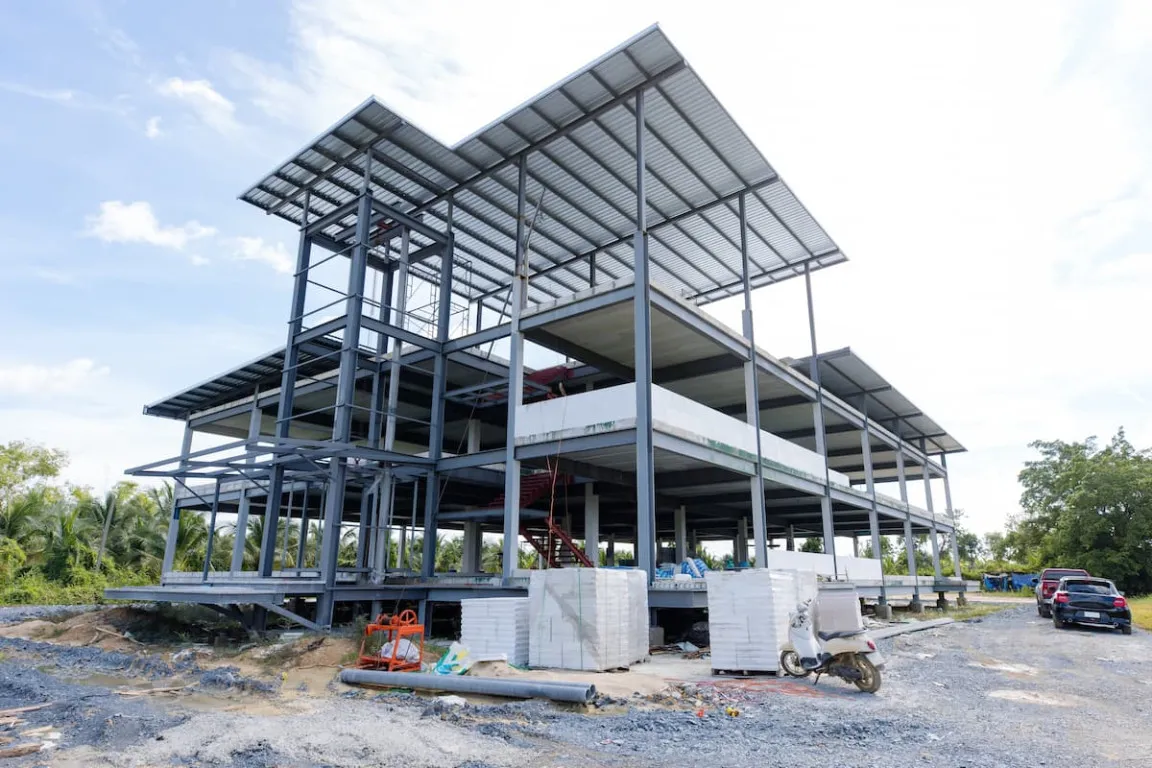
Planning to build a prefab house? This method is becoming increasingly popular because it offers a faster construction process while maintaining quality.
Prefab houses use concrete components that are manufactured in advance at a factory to specific sizes and standards, then shipped to the site for assembly, making the construction process more efficient than conventional methods.
Besides speeding up construction, precast concrete also offers more consistent quality and can help reduce challenges during the construction process.
So, what exactly is a prefab house, and what are its advantages? Read the full discussion so you can make the right choice before you start building your house.
What Is a Prefab House?
Simply put, a prefab house is a house built using precast concrete components. This concrete is cast in a factory to sizes tailored to construction needs and then assembled at the construction site.
Since the components are ready-made, the construction process is more practical and eliminates the need for on-site concrete pouring. The house is named prefab because it uses a knock-down or modular assembly system.
This system makes the structure more flexible, allowing it to be expanded or moved to another location if necessary. A similar concept is also applied to modular houses.
The difference is that modular houses generally use sandwich panels, although some also incorporate precast concrete components into their construction.
Differences Between Prefab Houses and Modular Houses
Both prefab and modular houses are considered prefabricated structures because they use a knock-down or assembly-and-disassembly system.
Both also offer a faster construction process compared to conventional methods. However, there are several differences you should be aware of. Below is the explanation:
1. Component Form
Prefab houses are shipped from the factory as separate concrete panels, including walls, floors, and beams, which are precisely sized to meet construction requirements.
Meanwhile, modular houses leave the factory as complete, self-contained room modules or cubes, including everything from the basic structure, walls, floors, and ceilings to electrical and plumbing systems.
2. On-Site Construction Process
For prefab houses, workers on-site still need to assemble and connect the concrete panels one by one at the project site to form a complete building.
In contrast, on-site work for modular homes is minimal, fast, and clean because workers only need to arrange and connect the ready-made room blocks from the factory.
3. Level of Flexibility
Prefab houses rely heavily on a knock-down or modular system, which provides flexibility for homeowners who wish to instantly expand their living space or relocate the structure in the future.
On the other hand, modular houses are a further development of the prefabrication system, offering maximum practicality because the units are nearly fully assembled right from the factory.
Read also: Get to Know Conventional Concrete, Its Advantages & Disadvantages
Advantages of Prefab Houses
Prefab houses offer various advantages, ranging from a faster construction process to better-maintained construction quality. Here are some advantages that make this method increasingly popular:
1. More Affordable
If you want to save on construction costs, a prefab house can be the right choice. In addition to the competitive price of precast concrete panels, this method also helps reduce total construction costs by about 10% compared to conventional methods.
These savings stem from more efficient use of formwork at the factory and reduced on-site labor requirements, since most components are pre-manufactured.
2. Faster
One of the main advantages of prefab houses is that the construction process is much faster. While foundation work is underway on-site, concrete components can be produced simultaneously at the factory, cutting construction time by up to 50% compared to conventional methods.
Once the site is ready, the precast concrete components are simply shipped and assembled without the need for on-site casting or curing. Using this method, a house can be completed in a matter of weeks, rather than months.
3. Guaranteed Quality
Compared to conventional methods, prefab houses offer more reliable quality because the entire production process takes place in a factory under controlled conditions. As a result, the quality of the concrete is not easily affected by weather or site conditions.
From material measurement and mixing to the curing process, every stage is strictly monitored using technology to ensure uniform dimensions and strength. Consequently, precast concrete is consistent in quality, strong, and meets specifications.
Read also: The Concept of Growing House: Building a House Step by Step
4. High Durability
Precast concrete walls are highly resilient in withstanding structural loads and external disturbances.
With high-quality materials and reinforcing frames produced to strict technical standards, this material remains highly stable when exposed to high humidity, extreme temperatures, and potential seismic shocks.
The robust characteristics of precast concrete make it ideal for buildings in tropical regions with extreme climates, such as Indonesia, particularly in areas prone to natural disasters.
5. Environmentally Friendly
Building a house using the prefabricated method keeps the construction site cleaner and more organized because the concrete panels are manufactured in a factory.
This way, dust, noise, and material waste at construction sites can be minimized. Additionally, leftover materials at the factory can be managed more efficiently, and some can even be recycled.
One example is Semen Merah Putih, which has implemented environmentally friendly technology by using non-OPC cement to support sustainable construction.
Build Prefab Houses with High-Quality Products from Beton Merah Putih
Precast houses offer many advantages, ranging from faster construction and more cost-efficient solutions to maintaining building quality. However, these benefits will be maximized when supported by high-quality concrete materials.
For this reason, you can entrust your construction needs to Beton Merah Putih, a subsidiary of Semen Merah Putih that provides innovative concrete solutions, including Precast Concrete, Ready-Mix Concrete, and aggregates for various construction needs.
Precast Concrete from Beton Merah Putih, for example, is designed to high-quality standards, making it suitable for a wide range of projects, including houses, buildings, and infrastructure.
Backed by a wide range of quality options and a team of experienced experts, Beton Merah Putih is ready to provide construction solutions that are efficient, sturdy, and tailored to your project’s needs.
So, are you ready to build a prefab house? Contact us now to learn more and discover the best construction solutions with Beton Merah Putih.
Read also: 15 Types of Raw Materials for Building and What They Do