
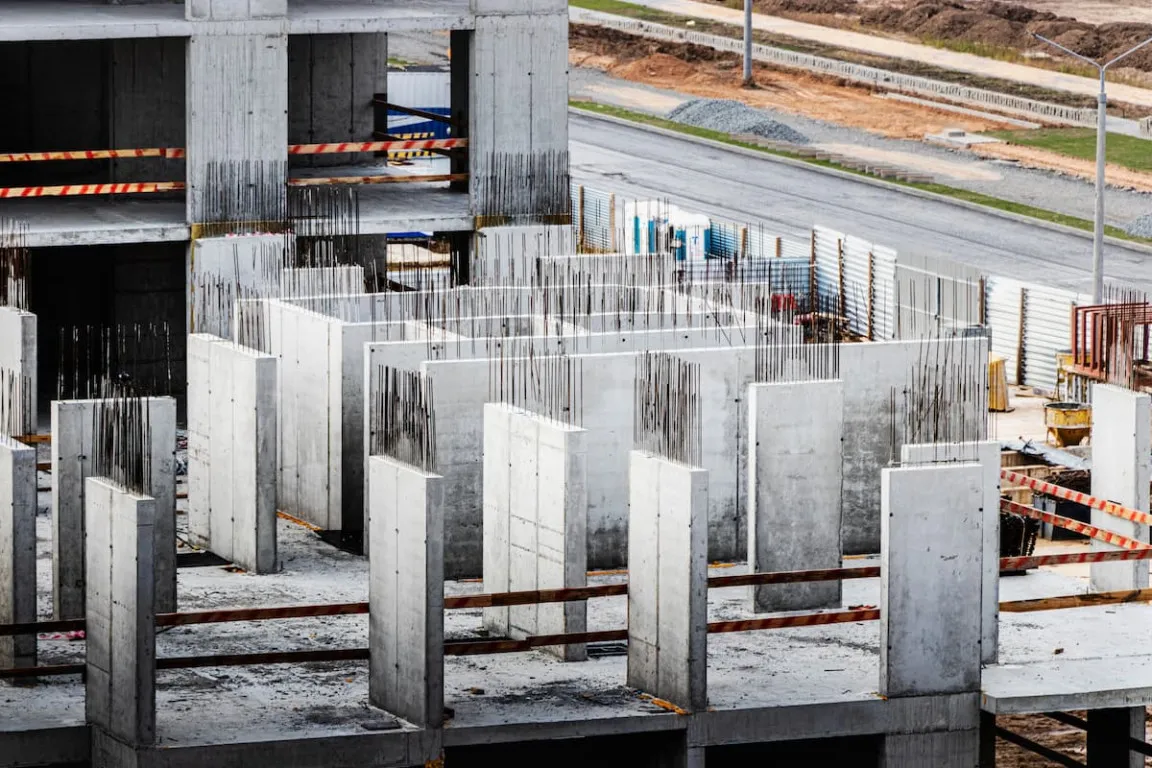
When constructing large buildings such as apartments, schools, or other large-scale construction projects, pile caps are required to support the building’s weight and the floors above it.
Pile caps are typically composed of a reinforced steel framework cast with precast or ready-mix concrete. Want to learn more about what a pile cap is, its function, composition, and construction process? Read this article to the end!
What Is a Pile Cap?
A pile cap is often described as a connector whose primary function is to transfer the load from the upper part of the building to the ground below.
The presence of a pile cap in construction plays a crucial role in maintaining the building's strength, stability, and structural integrity. With a pile cap in place, the load from the upper levels of the building can be distributed evenly.
Functioning as a support, a pile cap consists of a strong steel framework filled with concrete. This combination results in a pile cap structure that is strong against heavy loads and highly durable.
In construction projects, the size and composition of pile caps vary depending on the building’s area and the height of the levels being constructed.
Functions of a Pile Cap
Now that you know what a pile cap is, you might be wondering how important it is for a building and what its main functions are. Here are the functions of a pile cap:
- Load distribution: The primary function of a pile cap is to transfer the building’s load from the upper structure and distribute it evenly to the lower foundation.
- Maintaining building stability: A building is at high potential for damage if it is unstable. With a pile cap, the building becomes more stable, sturdy, and resistant to weather pressures or vibrations.
- Protection against shear forces: A pile cap helps minimize shear forces and pressure on the building.
- Reducing the risk of ground settlement: Ground settlement can occur if pressure on the building is unevenly distributed. In this case, a pile cap helps distribute pressure evenly and reduces the risk of ground subsidence.
Read also: Precast Concrete: Definition, Functions, and Types
Composition of a Pile Cap
Given its critical role in a construction project, a pile cap must be made from high-quality materials. The following are some components of a pile cap:
1. Reinforcing Steel
Reinforcing steel is the main component that allows the pile cap to stand and provides structural strength. Reinforcing steel typically has a diameter ranging from 16 mm to 29 mm, and may be larger depending on the scale of the construction.
The reinforcing steel is arranged in a framework or mesh according to calculations by construction experts, and this framework is then filled with concrete.
2. Concrete
The next component of the pile cap is the concrete mix. The choice of concrete material must not be made carelessly. Concrete quality must be taken seriously and must meet a minimum standard of f’c 30 MPa.
The larger the scale of the construction project, the higher the required concrete quality must be to support the building’s load.
3. Concrete Decking
Concrete decking is a small element shaped like a beam or cylinder made of concrete. It helps keep the rebar in its proper position during pouring.
4. Formwork
Simply put, formwork is a mold used to shape the concrete mix into the desired structure. Since the concrete mix has a slurry-like texture before hardening, formwork is crucial to ensure the casting process runs smoothly.
Read also: 5 Effective Tips for Concrete Casting
Stages of Pile Cap Construction
Now that you understand what a pile cap is, its function, and its components, you might be curious about how it is constructed. Here are the stages involved in building a pile cap:
1. Preparation Stage
To begin constructing a pile cap, a preparation stage is required, starting with creating structural design drawings and calculating its location.
In a building, there are several pile caps. Therefore, their spacing and locations must be correctly positioned according to calculations by construction experts. Once the design is complete, the area is cleared.
The area where the pile cap will be constructed must be cleared of any construction waste or other foreign objects that could compromise the stability of the concrete.
2. Soil Excavation
Once the soil at the pile cap site has been cleared and prepared, the soil excavation phase begins. The purpose of this excavation is to reach the precise foundation depth for the pile cap as specified in the structural engineer’s design.
The required excavation depth typically depends on the number of piles, the building load, soil stability, and the height of the pile cap.
3. Cutting the Piles
After excavation is complete, the process continues with cutting the piles. This cutting is done to ensure the pile ends are at the correct height.
After cutting, the pile leaves a rebar stub that will later serve to attach the reinforcing steel and optimally support the building structure.
4. Formwork Installation
The next step is the formwork installation for the concrete. Formwork is typically made from various materials such as wood, boards, plywood, or steel. It is installed tightly and securely to prevent concrete from spilling and to ensure it hardens into the desired shape.
5. Preparation of the Working Surface
Next, we move on to preparing the working platform. During pile cap construction, a level, safe, and stable working platform is required. Typically, the working platform is created by backfilling the soil to a height of 5–10 cm.
6. Reinforcement Installation
The next step in pile cap construction is the installation of reinforcement. This stage is critical and requires precision. Reinforcement is typically placed at the top, bottom, sides, and at the joints.
7. Concrete Pouring
The next key step is concrete pouring. The concrete typically used for pile caps is ready-mix concrete or other concrete mixtures that meet the required strength standards.
Pour the concrete mixture into the formwork and use a concrete vibrator to ensure the mixture is applied evenly. Ensure that during pouring, there is no rebar shifting or leakage through the formwork layers.
That concludes the explanation of pile caps that you need to know for construction. Obviously, high-quality concrete is required to build pile caps. For this, you can utilize solutions from Semen Merah Putih, which offers high-quality Beton Merah Putih products in the form of Ready-Mix Concrete and Precast Concrete.
We also provide Value-Added Solutions, including consultation services and the development of innovative products to support your project.
What are you waiting for? Contact us now for more information about Semen Merah Putih products that meet your needs!
Read also: Reinforced Concrete: Definition, Advantages, and Types