
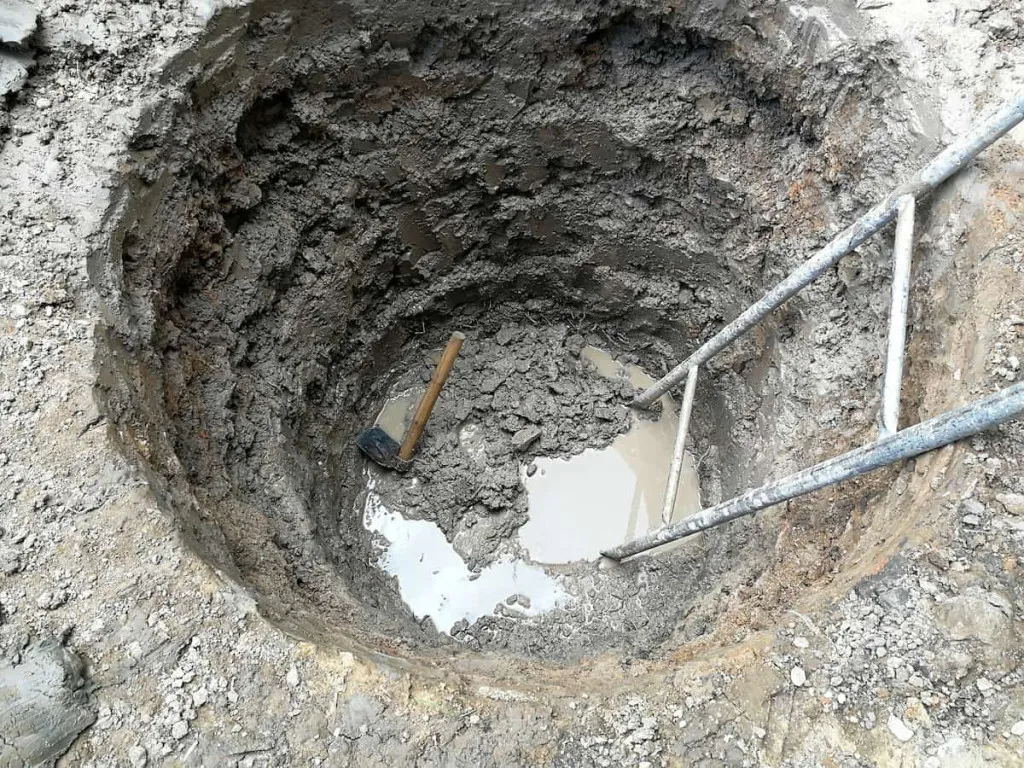
Every building requires a strong support system to bear and transfer loads to the ground. One such system is the well foundation. This type of foundation is often chosen because it is cost-effective and suitable for various construction projects.
Although it offers many advantages, installation still requires meeting certain requirements and adapting to local soil conditions. Curious to learn about its advantages and how to build one? Let’s take a look at the full review below so you can make the right choice!
What Is a Well Foundation?
A well foundation, also known as a cyclop, is a deep foundation shaped like a circular cylinder, resembling a well.
It is constructed from an arrangement of concrete pipes or columns embedded in the ground, with the voids tightly filled with stone fragments and then cast in place. It plays a crucial role in supporting the building’s load while simultaneously reinforcing the soil to keep it stable and prevent landslides.
As a hybrid between shallow foundations and pile foundations, this type is ideal for vertical structures on hard soil at depths of 3–5 meters, as well as on special sites, such as rocky areas and hillsides.
No wonder that it is frequently used in projects ranging from apartment complexes and high-rises to bridges and towers.
When Should Well Foundations Be Used?
Well foundations are best suited for sites with low bearing capacity, special geotechnical conditions, or hard soil at a depth of 3 to 5 meters. Forcing a directly applied foundation type at depths of less than 3 meters often wastes material because the excavation is too deep and too wide.
The same applies to concrete slab foundations on sites with high surface water levels, where construction is more difficult because water must be continuously pumped out of the excavation area. Therefore, this foundation serves as an effective option for overcoming these challenges.
Read also: Types of Footplate Foundation with the Pros and Cons
Advantages of Well Foundations
Just like other types, well foundations offer several advantages for supporting building structures. Here are some of the main advantages you should know:
1. Suitable for Unstable Soil
Unstable soil, such as muddy areas, former landfill sites, and waterlogged ground, can make it difficult to construct substructures because it behaves differently from dry soil.
However, well foundations adapt well to complex soil conditions, helping the construction process proceed smoothly.
2. Simpler Construction Process
Another advantage of this foundation is its practical construction. The entire process is carried out manually, without the need for heavy equipment, allowing you to cut costs without worrying about renting or purchasing expensive machinery.
3. Capable of Supporting Heavy Loads
In terms of durability, well foundations are highly reliable. Since they can be driven down to the hardest soil layer, these foundations can withstand extremely heavy loads.
Their ability to support heavy loads makes them ideal for use as supports for large-scale structures or as foundations for high-rise buildings.
4. More Environmentally Friendly
Foundation construction typically generates noise from excavation and strong vibrations that can damage surrounding buildings. You won’t encounter these issues with well foundations.
Minimal noise pollution keeps the construction process from disturbing residents’ peace, while the lack of strong vibrations maintains environmental stability and protects surrounding buildings.
5. More Affordable Construction Costs
For those seeking a budget-friendly foundation solution, this type is the best choice. These cost savings stem from its simple structure, which requires no heavy equipment and uses relatively few materials.
Main expenses are limited to fill materials, such as concrete and split stone, so the overall project budget stays within reasonable limits.
6. An Alternative to Deep Foundations
This foundation type is the best alternative in the deep-foundation category. The construction process is also easier and more practical, especially if you have access to, or an abundant supply of, stone materials at the construction site.
Read also: Foundation for A 2-Story House: Types & Key Influencing Factors
How to Build a Well Foundation
You can carry out the construction process for a well foundation in stages to ensure a sturdy, precise result. Here are the steps for building a well foundation:
- Planning and design: Start by calculating the building’s load and analyzing soil conditions. From there, you can precisely determine the pile diameter, length, and spacing.
- Material selection: Once the design is ready, determine the pile material and its core. Common materials include reinforced concrete, brick, wood, or other options suited to the project’s needs.
- Pile installation and reinforcement: Next, drive the piles into the ground until they are securely set. For reinforced concrete piles, a steel reinforcement cage is often added to increase load-bearing capacity.
- Filling and compacting the posts: The cavities of the installed posts are filled with crushed stone and ready-mix concrete, then compacted. Afterward, level the tops of the posts so they are flush with the ground surface.
- Strength testing: Before beginning upper-structure construction, visually inspect all piles and assess their stability to ensure the foundation can fully support the building.
What to Consider When Using Well Foundations
Before deciding to use this type of foundation, there are several technical risks you should be aware of, including:
- Dependence on weather conditions: Because the work relies on manual labor, bad weather can disrupt the process and potentially lead to failure. As a precaution, you can set up a protective tent over the excavation area.
- Sensitivity to soil conditions and density: This foundation type is relatively sensitive and not well-suited to sandy sites, as incorrect calculations can trigger landslides.
- Potential for soil collapse during drilling: Excavating soft soil with a drill to reach a solid layer can cause the surrounding soil structure to slide or collapse.
Choosing the right foundation type is the most important first step in ensuring a building's long-term stability and durability. However, structural integrity depends not only on foundation design but also on the quality of the materials you choose.
As a solution, choose Semen Merah Putih Watershield. This super-premium, multipurpose cement outperforms ordinary cement by a wide margin, making it ideal for use in every stage of construction, from foundations and concrete slabs to concrete pouring, bricklaying, plastering, and finishing.
With its innovative water-repellent technology, this cement provides powerful triple protection, preventing water seepage from outside, inside, and the ground. As a result, your building’s structure becomes stronger, more durable, more resistant to extreme weather, and requires lower maintenance costs.
Want your project to be a success with optimal results? Contact us today for the best deals and construction solutions, backed by our top-quality products and services!
Read also: Staddle Stone Foundation: Definition and How to Install It