
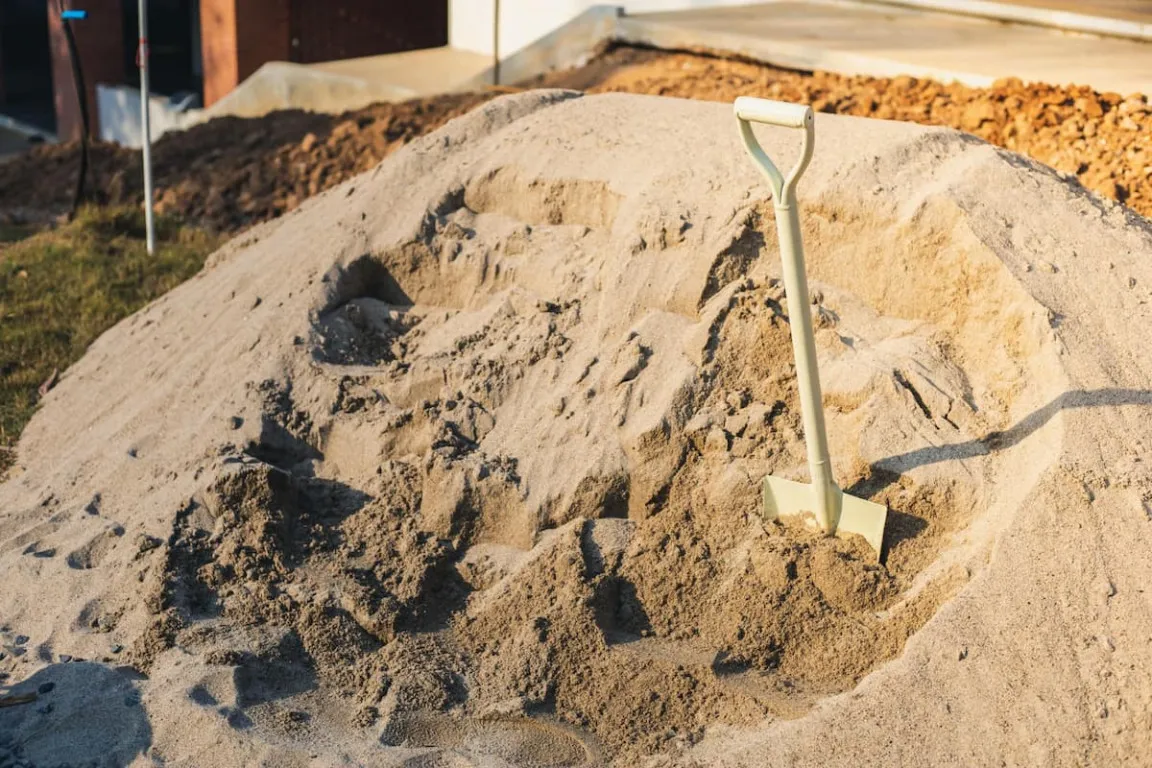
Knowing the amount of sand needed for bricklaying is essential to ensure the construction process is more economical and well planned.
Every construction job has different material requirements because its objectives are not the same. For this reason, the amount of cement and sand used for bricklaying cannot be directly compared to other jobs, such as plastering.
Even if you are not a contractor, it is still necessary to understand how to calculate material requirements so that you can estimate the costs more accurately and prevent unnecessary material waste.
If you are planning to build a house, read the following explanation to make the calculation process easier and more precise.
How to Calculate Sand Requirements for Bricklaying
In the bricklaying process, the amount of sand required depends on the mixture ratio between cement (PC) and sand (PP). Each ratio affects the strength of the masonry and the efficiency of material efficiency.
Here are some examples of how to calculate sand requirements for half-brick masonry using different PC:PP mixture ratios.
1. Half-Brick with 1 PC : 3 PP
Based on the Indonesian National Standard (SNI) 2008, brickwork measuring 5 × 11 × 22 cm over a wall area of 1 m² requires approximately 14.37 kg of cement (PC) and 0.04 m³ of sand (PP). If the wall to be built measures 11 meters × 4 meters, the total area is 44 m².
The material requirements can be calculated as follows:
- Wall area: 11 × 4 = 44 m²
- Cement requirement: 14.37 × 44 = 632.28 kg → approximately 15.8 bags (assuming 1 bag = 40 kg)
- Sand requirement: 0.04 × 44 = 1.76 m³
By performing these calculations, you can use materials more efficiently while ensuring the construction meets technical standards. If necessary, you can also consult experts to ensure the calculations and the building's quality remain optimal.
2. Half Brick with 1 PC : 4 PP
For a half-brick wall pairing with a ratio of 1 PC : 4 PP, the material requirements per 1 m² are approximately 9.68 kg of cement (PC) and 0.043 m³ of sand (PP). If the wall to be built measures 11 m × 4 m, the total area is 44 m². The details of the material requirements are:
- Wall area: 11 × 4 = 44 m²
- Cement requirement: 9.68 × 44 = 506 kg → approximately 12.65 bags (assuming 1 bag = 40 kg)
- Sand requirement: 0.043 × 44 = 1.89 m³
By following these calculations, material usage can be adjusted more efficiently, ensuring that construction remains economical and stays within the requirements specifications.
Read also: How Much Sand Requirements for Cast Per M3? Here’s the Answer!
3. Half Brick with 1 PC : 5 PP
For half brick masonry with a mixture of 1 PC: 5 PP, the material requirement per 1 m² is approximately 9.68 kg of cement and 0.045 m³ of sand. If the wall measures 11 m × 4 m, the area will be 44 m². The calculation details are as follows:
- Wall area: 11 × 4 = 44 m²
- Cement requirement: 9.68 × 44 = 425.92 kg → approximately 10.64 bags (assuming 1 bag = 40 kg)
- Sand requirement: 0.045 × 44 = 1.98 m³
With this calculation, material consumption can be adjusted more precisely, making bricklaying work more efficient and sturdy.
4. Half Brick with 1 PC : 6 PP
In a half brick with a mixture of 1 PC: 6 PP, the material requirement per 1 m² is approximately 8.32 kg of cement and 0.049 m³ of sand. If the wall measures 11 m × 4 m, the area is 44 m² with the following total material requirements:
- Cement (PC): 8.32 × 44 = 366.08 kg → approximately 9.15 bags (assuming 1 bag = 40 kg)
- Sand (PP): 0.049 × 44 = 2.15 m³
With this calculation, the mixture ratio can be adjusted more accurately, ensuring the volume of material remains as needed and maintaining the stability of the wall.
5. Half Brick with 1 PC : 8 PP
For half brick masonry with a mixture of 1 PC : 8 PP, the material requirement per 1 m² is approximately 6.5 kg of cement and 0.05 m³ of sand. If the wall measures 11 m × 4 m (area 44 m²), the total requirements are:
- Cement (PC): 6.5 × 44 = 286 kg → approximately 7.15 bags (assuming 1 bag = 40 kg)
- Sand (PP): 0.05 × 44 = 2.2 m³
This calculation makes material consumption more targeted and in line with the dimensions of the wall constructed.
Read also: Silica Sand: What Is It Used for in Construction?
The Importance of Calculating Cement and Sand Requirements
After understanding how to calculate the sand and cement requirements for brickwork, it is also important to know why these calculations should not be done carelessly.
Accurate material calculations help ensure that the construction process runs efficiently and produces optimal results. Below are several reasons why calculating cement and sand requirements properly is essential:
- Maintaining construction quality: The right amount of material makes the mixture stronger and more durable. If the proportions are incorrect, the walls can become less stable and be damaged quickly.
- Cost efficiency: Accurate material estimates prevent overpurchasing or material shortages, allowing project costs to be better controlled.
- Maximum results: A mixture that meets standards produces neater, more stable brickwork that is resistant to loads and weather.
- Reducing material waste: Careful calculations help minimise unused cement and sand, making it more cost-effective and reducing waste.
- Speeding up the work process: The availability of materials as needed helps the construction process run more smoothly without the problem of material deficiency.
- Getting the right cement mixture: By calculating material requirements, the mixture's composition becomes more precisely measurable, resulting in better quality and a more solid structure.
That is how to calculate sand requirements for bricklaying, allowing for more efficient and accurate wall installation in line with the plan. With accurate calculations, you can estimate costs while minimizing the risk of material waste during the construction process.
In addition to calculating requirements manually, you can also utilize ready-to-use material solutions to accelerate construction work.
One of them is ready-mix concrete from Beton Merah Putih, a subsidiary of Semen Merah Putih that offers high-quality Ready-Mix Concrete, Precast Concrete, and Aggregate products for various types of construction applications.
Ready-mix concrete products from Beton Merah Putih are designed to be more practical, efficient, and consistent in quality, making them ideal for residential projects, commercial buildings, and large-scale infrastructure. With the support of an experienced team of experts, the application process becomes faster and compliant with construction standards.
Still unsure which concrete solution best suits your project needs? Contact us immediately and get the best material recommendations for stronger and more durable construction.
Read also: The Right Ratio of Cement and Sand for A Sturdy Building