Mini soccer is becoming increasingly popular, both as a recreational sport and as a competitive event in various regions. This trend has encouraged many communities and business owners to build their own fields as part of the development of promising real estate properties or commercial buildings. Are you also interested in taking advantage of this opportunity?
Before starting this project, you should understand the dimensions of a mini soccer field. The proper mini soccer field dimensions will ensure the comfort and quality of the matches. Read on for a detailed explanation in this article.
What Is Mini Soccer?
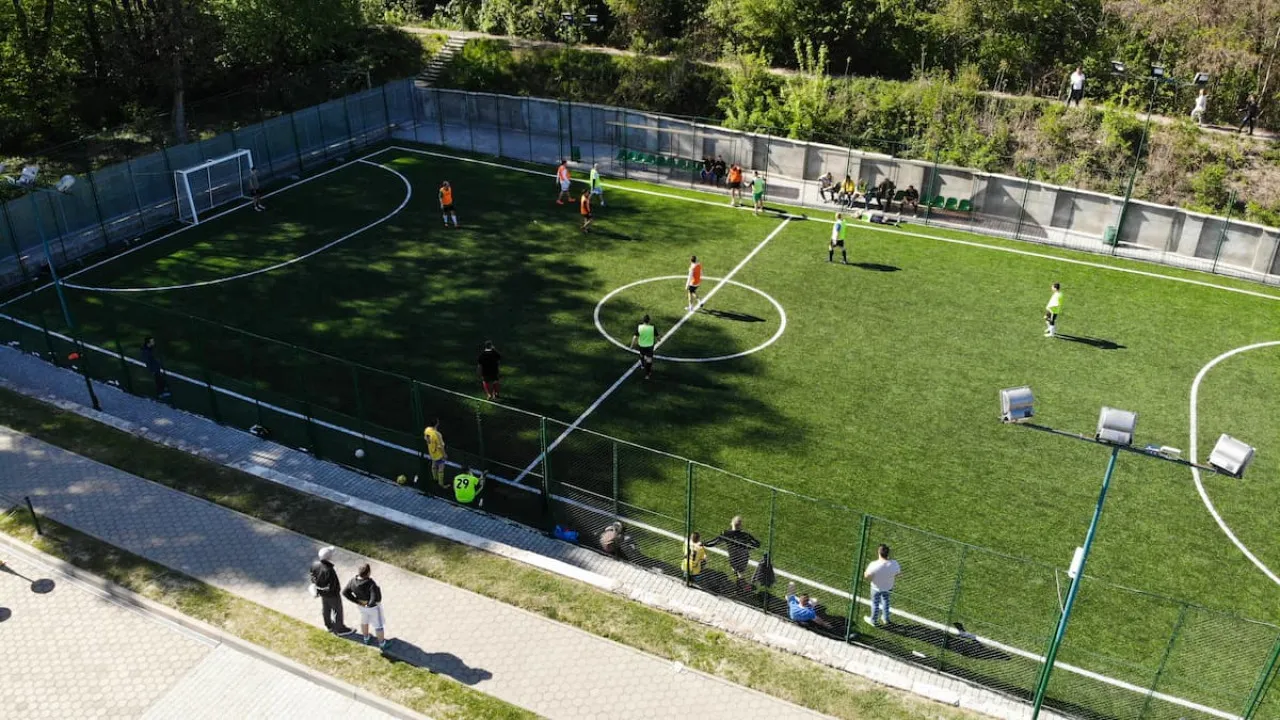
Mini soccer is a variant of soccer played with fewer players and on a smaller field compared to conventional soccer.
So, how many players are in a mini soccer game? Generally, each team consists of 5 to 7 players, making the pace of the game feel faster, more intense, and more dynamic.
This sport is usually played on synthetic turf fields, both indoors and outdoors, with relatively short match durations.
The rules are also more flexible than conventional soccer because they can be adapted to the needs of the tournament or field management.
International Standard Mini Soccer Field Dimensions
In official matches, the international standard dimensions for a mini soccer field are widely used as a reference in many countries. Each element of the field has specific size requirements established by the World Minifootball Federation (WMF). Check the details in the following breakdown:
1. Field Length and Width
The length of an international standard mini soccer field is generally between 46 and 50 meters. The width ranges from 26 to 30 meters, depending on the applicable competition regulations. These dimensions are designed to ensure the game remains fast-paced, competitive, and comfortable for all players.
2. Penalty Area
The penalty area is a crucial part of a mini soccer match. Generally, the penalty area consists of two lines, 5 meters from the goal line, extending 7 meters into the field. These two lines are then connected by a line parallel to the goal, spanning 14 meters.
3. Marking Lines
Every mini soccer field has marking lines that delineate the playing area. The lines are generally about 8–12 cm wide and must be clearly visible to assist the referee and players. These lines include the center line, sidelines, goal lines, and the center circle.
4. Distance Between Field Lines
Each line has a specified distance, including the center line and the center circle. The center circle typically has a radius of about 3–5 meters. These distance specifications are important to ensure that starting positions and game restarts are conducted in accordance with the rules.
5. Goal Dimensions
International mini soccer goals are typically 2 meters high and 4 meters wide. These dimensions are scaled to the field size to maintain proportionality. This standard helps balance the goalkeeper’s abilities with players’ scoring opportunities.
Read also: A Guide to Building Construction Services & Their Fields
National Standard Mini Soccer Field Dimensions
So, what about the standard dimensions for national mini soccer fields? Mini soccer regulations in Indonesia follow guidelines set by the Indonesian Mini Soccer Federation (Federasi Sepak Bola Mini Indonesia/FSMI), which align with those of the World Minifootball Federation (WMF).
Generally, the standard length of a national mini soccer field ranges from 46 to 55 meters, with a width of approximately 26 to 35 meters. The penalty area measures 12 x 13 meters, with the penalty kick spot located 9 meters from the goal line. Meanwhile, the goal is 2 meters high and 5 meters wide, proportional to the field’s dimensions.
Types of Mini Soccer Field Surfaces
The choice of surface for a mini soccer field significantly impacts playing comfort, player safety, and long-term maintenance costs. To date, there are at least two types of mini soccer field surfaces that are most commonly used. Here is the explanation:
1. Synthetic Turf
Synthetic turf is the most popular choice for mini soccer fields, especially in urban areas. This is because synthetic turf is relatively weather-resistant and can withstand heavy outdoor use. Additionally, it requires less maintenance compared to natural grass.
2. Concrete with Synthetic Turf
Concrete with synthetic turf for mini soccer fields uses a strong concrete base as the field’s primary foundation. A special sports-grade synthetic turf or carpet is installed on top to provide a more comfortable surface.
Read also: Floor Plate: Definition, Functions, Types, and Advantages
Benefits of Standardizing Mini Soccer Field Dimensions
Standardizing mini soccer field dimensions is not merely a formality but a crucial foundation for organizing professional matches. Here are some of the main benefits.
1. Ensuring Consistent Rules of the Game
Field dimensions that meet standards ensure that the rules of the game can be applied consistently. The distance between lines, penalty spots, and goal dimensions all influence referees’ decisions and team strategies. With clear standards, the potential for differing interpretations during matches can be minimized.
2. Simplifying Field Management
Standardizing field dimensions makes the management process more practical and efficient. Managers can rent out fields for everything from practice sessions to tournaments and need to make numerous adjustments when hosting different competitions.
Additionally, standard-compliant dimensions simplify routine maintenance, renovation planning, and the calculation of material requirements. As a result, field operations can run more structured and professional.
That concludes the comprehensive explanation of mini soccer field dimensions, covering national and international standards and the types of surfaces commonly used. By accurately understanding each dimension, you can ensure that the field built is comfortable, safe, and compliant with regulations. Thorough planning also improves the game quality and investment value, particularly for sports facilities and commercial buildings.
However, during construction, selecting high-quality materials is crucial to ensuring the field is strong and durable. To meet the needs of pouring the base floor, support structures, and the areas surrounding the field, Semen Merah Putih offers Semen Merah Putih ULTRAMIX-G, designed to enable stronger, more efficient construction.
Semen Merah Putih ULTRAMIX-G is a high-quality Portland cement specially formulated for ready-mix and precast concrete. This cement offers optimal compressive strength, ease of application, and consistent quality, resulting in dense, durable concrete. With these characteristics, Semen ULTRAMIX-G is the ideal choice for constructing strong and highly durable mini soccer fields.
Are you planning to build a mini soccer field or undertake another construction project? Trust your material needs to Semen Merah Putih and choose the product that perfectly suits your project specifications. Contact us now to get complete information and the best solutions for your construction project!
Read also: How to Calculate Cement Requirements: Here’s the Guide