
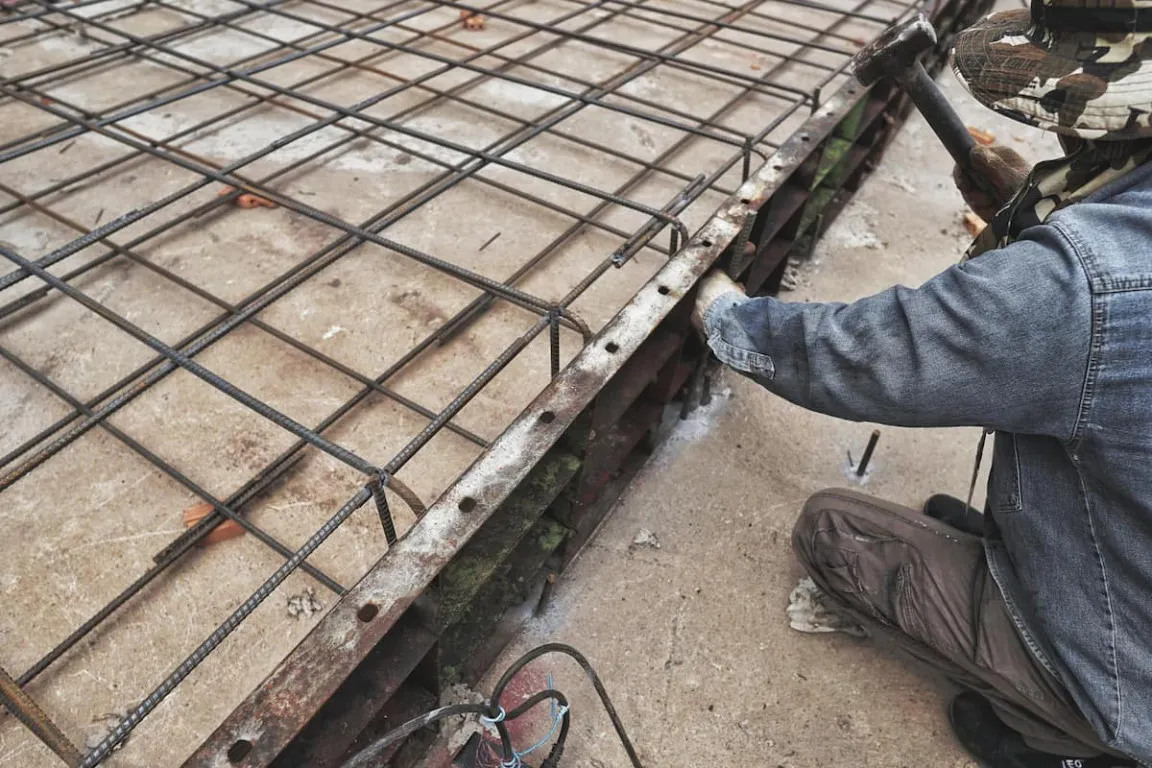
Floor plate reinforcement is an important method for strengthening a building's structure, especially the thin and vulnerable floors.
This process is carried out by installing steel frames on the floor plate, typically in two layers, to make the building stronger and safer, particularly under heavy loads.
The steel size and installation spacing are adjusted based on the floor's function and the loads it will bear, so there is no fixed-diameter rule. This method is commonly applied to two-story or taller buildings, but it can also be used in single-story buildings.
To understand the benefits and complete steps of floor plate reinforcement, keep reading the following review!
What Is a Floor Plate?
A floor plate is the construction part that serves as a footing. The construction of a floor plate is just as important as other construction elements, such as columns and foundations. Inadequate planning or execution can cause vibrations when the floor plate bears a load.
How to Do a Floor Plate Reinforcement
After understanding what a floor plate is, the next step is to learn how to reinforce a floor plate and its details. This process involves several important stages. Here is how to do a floor plate reinforcement.
1. Installation of Reinforcement at the Bottom
A professional should carry out the process of reinforcing a two-layer plate. The first stage is to install the lower reinforcement or steel framework using sturdy concrete steel decking materials.
The concrete layer in this part generally has a minimum thickness of 20–25 mm. The thickness during application itself depends on the environmental conditions.
2. Installation of Reinforcement on the Upper Part
The upper reinforcement must be perpendicular to the bottom reinforcement to maintain the building's structural integrity. The distance between the bars should be at least 25 mm and ideally no more than 20 cm.
Read also: Characteristics and Ideal Thickness of Second-Floor Slabs
3. Installation of the “Chicken Legs” Section
The installation of the “chicken leg” section is intended to maintain the spacing between the upper and lower reinforcements. Chicken legs are made from high-quality steel pieces specially shaped to keep the reinforcement in a stable position.
4. Process of Cross-Tying with Concrete Wire
In addition to installing chicken legs, the reinforcement must be tied at the intersections with concrete wire to strengthen the structure. This process is usually performed by experts using specialized techniques to ensure the bindings remain strong and do not come loose.
5. Reinforcement Strength Inspection Process
The final stage is to check the strength of the installed reinforcement to ensure its quality. If any damage is found, repairs can be carried out through patching, chipping and concreting, or injection.
Benefits of Floor Plate Reinforcement
In addition to knowing how to install it, it is also important to understand the benefits of floor plate reinforcement. This process not only strengthens the foundation but also makes multi-story buildings safer and enhances the overall structure’s sturdiness.
Here are some benefits of floor plate reinforcement:
1. Strengthening the Foundation of Building Construction
The two-layer floor plate reinforcement works in conjunction with the columns through a frame system, increasing rigidity and distributing loads to the columns. With proper maintenance, these columns can last even longer, up to several tens of years.
2. Suitable for Multi-Story Buildings
Two-layer floor plate reinforcement is suitable for application in multi-story buildings or houses, ensuring the safety and sturdiness of the structure are maintained even as the building rises high.
3. Much Stronger Building Construction
The main benefit of two-layer floor plate reinforcement is to make the building construction stronger, safer, and waterproof (if additional waterproofing materials and dense concrete mixes are used).
Read also: Building Structures: Types, Elements, and Examples
How to Calculate the Floor Plate Steel Requirement
Determining the exact amount of floor plate steel is very important to ensure the house construction is sturdy and safe. Here are the steps to calculate the floor plate steel requirements:
1. Determine the Frame Area
The amount of floor plate steel depends on the house area. The larger the house, the more steel is needed. Additionally, the steel type is adjusted based on the room's function and the part of the house being built.
2. Ensure the Depth of Foundation Columns and Rings
Plain/twisted steel (rebar) is typically used for columns and foundation rings to provide additional structural strength.
3. Check Parts of the House That Need Steel Plates
Generally, steel plates are installed on the main framework, stairs, and certain parts that bear heavier loads.
4. Determine the Size of Reinforcement
Reinforcement strengthens the structure, especially in multi-story houses. The larger and more numerous the reinforcements, the more steel plates are needed.
5. Accurately Calculate the Diameter of the Steel Plate
The steel plate diameter must match the requirements and the house design, as it affects the amount of steel required.
6. Calculate Requirements for Multi-Story Houses
Generally, multi-story houses require more steel plates compared to single-story houses. Therefore, it is advisable to plan its application more carefully.
7. Floors Plate Steel Formula
The formula for calculating floor plate steel requirements is given as X rods and Y rods. The explanation is as follows:
Longitudinal direction (X)
Number of X bars = Plate width/spacing + 1
Total length of X bars = Number of X bars × Plate length
Transverse direction (Y)
Number of Y bars = Plate length/spacing + 1
Total length of Y bars = Number of Y bars × Plate width
Total floor plate steel = X direction steel + Y direction steel
Example of Calculating Floor Plate Steel Requirements
After understanding how to calculate the steel requirements for a floor plate, here is an example of its application. This process includes calculating horizontal and vertical steel requirements, as well as the total steel requirements, to ensure the floor construction is more accurate and robust.
1. Calculating Horizontal Steel
Horizontal steel functions to bear loads that act parallel to the floor surface. Here is how to calculate it:
- Measure the length of the floor plate, for example, 6 m × 3 m.
- Determine the spacing between the steel bars, the closer the spacing, the stronger the floor, for example, 20 cm (0.2 m).
- Calculate the number of steel using the formula:
Number of X bars = Plate width/spacing + 1
= (3/0.2) + 1
= 16 bars
Total length of X steel = Number of X bars × Plate length
= 16 × 6
= 96 m
Number of Y bars = Plate length/spacing + 1
= (6/0.2) + 1
= 31 bars
Total length of Y steel = Number of Y bars × Plate width
= 31 × 3
= 93 m
Total size of floor plate steel = 96 m + 93 m
= 189 m
Therefore, it can be concluded that the required steel is approximately 189 m.
2. Calculating the Total Steel Requirement
After calculating the horizontal and vertical steel quantities, the next step is to determine the total length of steel required. Here is the example calculation:
- Horizontal steel: 96 meters.
- Vertical steel: 93 meters.
- Total length of steel = 96 + 93 = 189 meters.
If the length per steel rod is 12 meters, then the number of rods needed is:
189 meters ÷ 12 meters/rod = 16 rods
This means that for the floor plate reinforcement, approximately 16 steel rods are required.
That concludes the complete explanation of floor plate reinforcement, from the definition and benefits to the proper installation method to ensure a stronger and safer building structure.
All this information is important to ensure your construction project uses appropriate and effective reinforcement methods.
To support optimal construction, you can also utilize premium concrete products from a trusted manufacturer, namely Semen Merah Putih.
Through its subsidiary, Beton Merah Putih, Ready Mix Concrete is available, ready to use, produced with the correct material mix in accordance with project specifications, and delivered quickly without disrupting productivity.
In addition, Precast Concrete is also available, which is practical, high-quality, precise, and strong, enabling faster completion while maintaining the safety and sturdiness of the building.
Contact us for more information about our flagship products and consultations regarding floor plate or building construction.
Read also: What Is a Waffle Slab? Definition, Function, & Implementation