
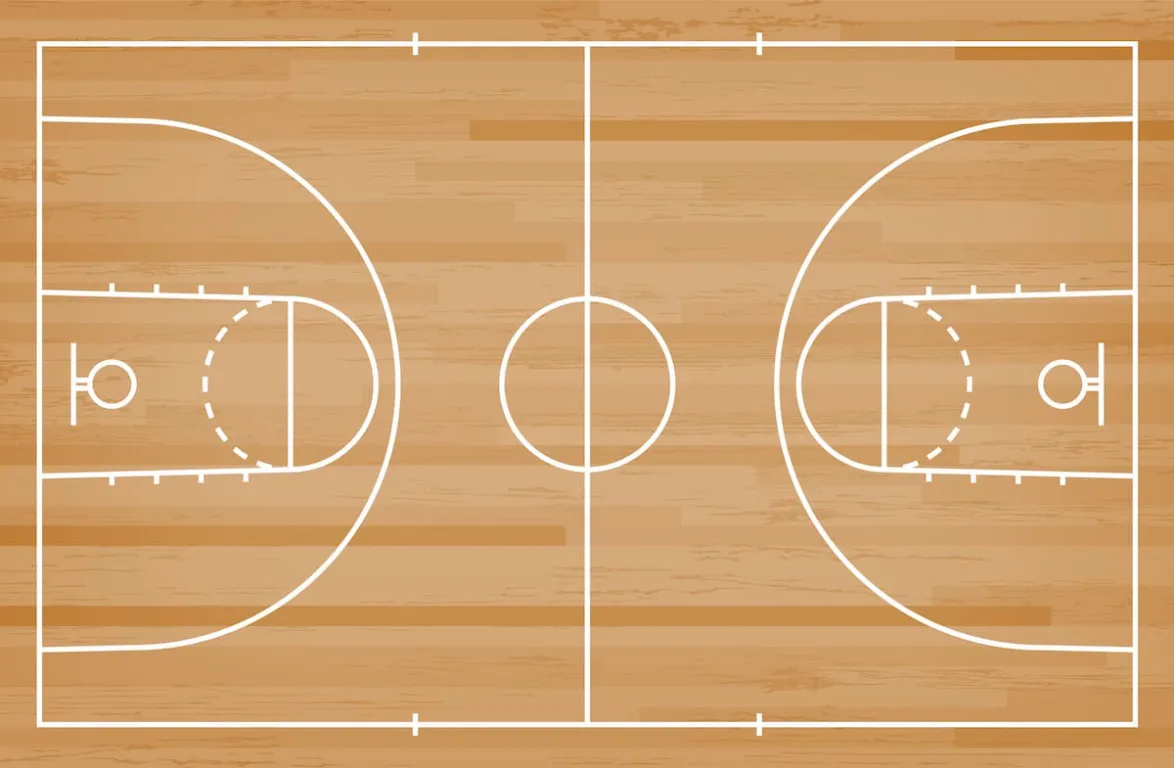
The dimensions of a basketball court are regulated by different official standards set by FIBA and the NBA. These differences arise from the organizations’ backgrounds, cultures, and the nature of the game as it has evolved in each region.
FIBA, as an international body, represents many countries with diverse playing styles, while the NBA has developed within American sports culture, featuring a playing style that tends to be faster-paced.
Standardization is established to ensure that games remain fair, consistent, and compliant with the rules, including dimensions, lines, and even the materials used for the floor. So, what are the correct dimensions for a basketball court? Find the answer below.
Standard FIBA Basketball Court Dimensions
According to FIBA regulations, basketball court dimensions are clearly defined to meet international standards. The court measures 28 meters in length and 15 meters in width, features a center circle with a 3.6-meter diameter, and includes a three-point line positioned 6.75 meters from the rim.
Additionally, there are several other important dimensions to note, such as the free-throw line distance and the rim height. Here is a summary of the basketball court dimensions:
- Court length: 28 meters.
- Court width: 15 meters.
- Center circle diameter: 3.6 meters.
- Three-point line distance: 6.75 meters.
- Arc radius: 1.25 meters.
- Free-throw line distance: 4.6 meters.
- Hoop height: 3.05 meters.
- Basket rim width: 0.45 meters.
- Court line width: 5 cm.
All of these dimensions are official references in FIBA standards and should be carefully followed when building a court that complies with the regulations.
Standard NBA Basketball Court Dimensions
Unlike FIBA, the standard NBA basketball court is slightly longer and wider. The court is 28.65 meters long and 15.24 meters wide. The diameter of the center circle is 3.66 meters, while the three-point line is 6.71 meters away.
For the rim height, the NBA maintains the same standard of 3.05 meters. There are also other important dimensions to note, particularly regarding the free-throw area. Here is a summary:
- Court length: 28.65 meters.
- Court width: 15.24 meters.
- Center circle diameter: 3.66 meters.
- Three-point distance: 6.71 meters.
- Free-throw line width: 5.79 meters.
- Length from the free-throw line to the three-point line: 7.24 meters.
- Hoop height: 3.05 meters.
These dimensions serve as the official reference in NBA standards and distinguish them from FIBA dimensions.
Read also: The Characteristics & Examples of Long-Span Buildings
Key Areas on the Basketball Court
Every line on the basketball court is not merely a boundary but serves an important function in the game. Here is a brief explanation:
1. Free-Throw and Paint Areas
The free-throw line is 4.6 meters from the backboard and serves as the unobstructed execution point for free throws. Additionally, this line helps regulate player positioning during free throws.
Meanwhile, the paint area is where physical battles take place, particularly for rebounds and post play. This area is 4.9 meters wide under FIBA standards. Therefore, players must observe the three-second rule to avoid committing a violation. This area often determines scoring opportunities.
2. Three-Point Line
The three-point line marks the boundary for three-point shots, measuring 6.75 meters in FIBA and 7.24 meters in the NBA. Its curved shape significantly influences perimeter offensive strategies.
This area also opens up strategic variations, whether to create shooting lanes or open up attack routes when the defense spreads out.
3. Center Line and Center Court
The center line in basketball divides the court and serves as the boundary for the backcourt. Once a player crosses this line, they are not allowed to return the ball into the defensive zone.
The center circle, with a diameter of 3.6 meters, is used for the tip-off at the start of the game and provides space for two players to compete for the first possession, helping to set the early game momentum.
The Importance of Building a Basketball Court with the Right Dimensions
The dimensions of a basketball court directly influence the rhythm of the game. The length, width, and shooting distances determine player movement, enhance strategic execution, and ensure a more comfortable playing experience.
Standard dimensions also help coaches design drills that are relevant to game situations. This allows athletes to get used to the correct playing patterns from the start. For referees, the correct dimensions make fair decision-making easier without causing misinterpretations.
Additionally, standard dimensions are related to safety as they provide sufficient space for stopping, jumping, and landing. By understanding a consistent court layout, players can more easily develop a focused and effective playing style.
Read also: Lean Construction: An Effective Way to Manage Building Projects
Tips for Building a Basketball Court at Home
Having a home basketball court is certainly a dream for many people. Not only is it more convenient for practicing anytime, but you can also play more comfortably without having to go to public facilities. Here are some tips for building a home basketball court:
1. Determining the Size and Design of a Home Basketball Court
The size of a home basketball court needs to be adjusted to the available space. A minimalist design is often chosen because it is more efficient yet still comfortable to use. Size options include:
- Full court: 28 meters x 15 meters, according to official standards.
- Half court: 15 meters wide and about 14 meters long, suitable for limited yards.
- Mini court: About 10 meters x 7 meters for tighter spaces.
The half-court size is quite popular because it strikes a balance between playing needs and available space.
2. Center Circle Dimensions
The center circle has a diameter of 3.6 meters in accordance with FIBA standards and is used for the tip-off. On smaller courts, the size can be adjusted to fit the court’s proportions, provided that its function and balance are maintained.
3. Choosing Materials for Outdoor Basketball Court Surfaces
In addition to size, material selection is crucial to ensure the court is durable and safe to use. Some common options include:
- Concrete: Strong and durable, but the surface is hard and can become slippery when wet.
- Asphalt: Softer than concrete and relatively more affordable, but requires regular maintenance.
- Special outdoor carpet: More comfortable and soft, but tends to be more expensive and requires extra maintenance.
By carefully considering size, design, and materials, you can create a comfortable, proportionate, and functional home basketball court that meets your playing needs.
That is an overview of standard basketball court dimensions and how to build one at home. By following the correct dimensions and details, the court you build will meet standards and be comfortable to play on.
In addition to paying attention to dimensions and lines, material quality should not be overlooked, especially if you are choosing concrete for the floor. Choosing the right cement will help ensure the surface is stronger, more durable, and minimize the risk of cracks or leaks.
For optimal results, you can choose Semen Merah Putih, which has earned a PLATINUM rating from the Green Product Council Indonesia (GPCI) due to its environmentally friendly formula and innovative technology, without compromising strength and durability.
For structural applications requiring high compressive strength, Semen Merah Putih FLEXIPLUS is also available, certified with a Gold-rated Green Label Indonesia (GLI). Meanwhile, Semen Merah Putih Watershield, with its water-repellent technology, provides triple protection against water seepage, making it ideal for concrete slabs, foundations, and site castings.
Planning to build a basketball court or undertake another construction project? Choose high-quality cement for stronger and more durable results. Contact us now and find construction solutions tailored to your needs.
Read also: The Upper and Lower Bridge Structure & Its Components